
Anti-Synthetase Syndrome or Perimenopause? 7 Red Flags
Confused by joint pain, fatigue, and 'hot flashes'? Learn how Anti-Synthetase Syndrome symptoms in women over 40 differ from perimenopause and why it matters.
Published:
Entering your 40s often feels like navigating a shifting landscape where your body begins to speak a different language. For many of us, the first signs of change—fatigue, aching joints, and temperature fluctuations—are quickly attributed to the transition toward menopause. However, there is a rare and serious autoimmune condition called Anti-Synthetase Syndrome (ASS) that shares a confusing amount of territory with perimenopause.
Understanding the nuances of anti synthetase syndrome symptoms in women over 40 vs perimenopause is crucial, as the former requires urgent intervention to prevent long-term lung and muscle damage. While perimenopause is a natural hormonal shift, ASS is a chronic autoimmune disorder characterized by specific antibodies that attack the body's own tissues.
What is anti-synthetase syndrome and why is it misdiagnosed as perimenopause?
Anti-synthetase syndrome is a rare subset of inflammatory muscle diseases (myositis). It is defined by the presence of anti-aminoacyl-tRNA synthetase antibodies, the most common being the Jo-1 antibody [Source: NIH / National Library of Medicine]. The syndrome typically presents with a triad of symptoms: interstitial lung disease (ILD), inflammatory myopathy (muscle inflammation), and inflammatory arthritis.
The reason for the frequent misdiagnosis in women over 40 lies in the overlap of systemic symptoms. When you visit a provider complaining of exhaustion, stiff joints, and "feeling hot," the statistical likelihood of perimenopause is high. Consequently, the subtle, early signs of autoimmune muscle weakness or breathlessness might be dismissed as "just getting older" or "hormonal fluctuations."
Unlike the gradual decline of estrogen detailed in our perimenopause symptoms checklist, ASS involves a targeted immune strike against the body’s cellular machinery. If your "menopause transition" feels unexpectedly aggressive or involves persistent coughing, it is time to look deeper.
Do your 'hot flashes' feel more like a low-grade autoimmune fever?
One of the hallmark experiences of the 40s is the hot flash. However, in Anti-Synthetase Syndrome, patients often experience what is known as "Raynaud's phenomenon" or low-grade fevers that mimic the heat of a vasomotor symptom.
In perimenopause, a hot flash is typically a sudden surge of heat that dissipates within minutes. In contrast, the fevers associated with ASS are often persistent, low-grade (between 99.5°F and 100.5°F), and accompanied by a profound sense of malaise. Furthermore, Raynaud’s phenomenon—where fingers turn white or blue in response to cold or stress—is a common feature of ASS but is not a standard symptom of estrogen loss [Source: American College of Rheumatology].
If you find yourself shivering one moment and feverish the next, don't automatically assume your hypothalamus is just reacting to low estrogen. You may want to compare these sensations to other autoimmune overlaps, such as how Hashimoto’s and perimenopause symptoms can similarly confuse the body's internal thermostat.
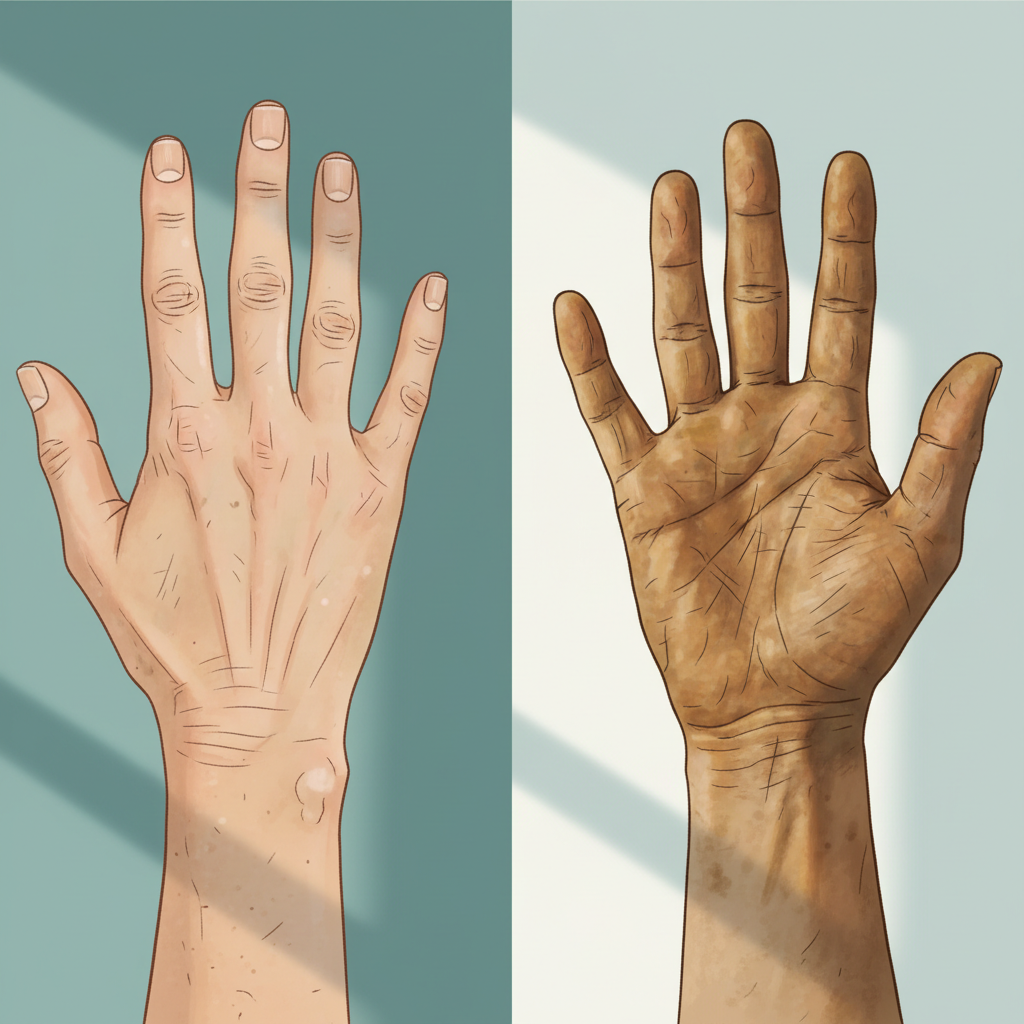
Mechanic's hands or dry skin: How to tell the difference in your 40s?
As estrogen levels drop, our skin loses its ability to retain moisture, leading to the characteristic "crepy" or dry skin of midlife. However, ASS presents a very specific dermatological sign known as "Mechanic’s Hands."
| Feature | Perimenopausal Dry Skin | Mechanic's Hands (ASS) |
|---|---|---|
| Appearance | Generalized dryness, thinning, itching | Hyperkeratosis (thickening), scaling, and cracking |
| Location | Face, arms, legs, and torso | Radial sides of the fingers and palms |
| Pain Level | Usually just itchy or uncomfortable | Can be painful with deep, "dirty-looking" fissures |
| Cause | Decreased sebum and collagen production | Autoimmune-mediated skin inflammation |
Mechanic’s hands get their name because the skin looks like that of a manual laborer who works with harsh chemicals—thick, cracked, and darkened. If your hand cream isn't helping and the skin along the sides of your thumbs is splitting, this is a major red flag that warrants an immunology consult.
Why are joint pain and shortness of breath red flags for ASS?
Joint pain is a pervasive complaint in the 40s, often linked to the loss of estrogen’s anti-inflammatory effects on the cartilage. You might read about this in our guide on fibromyalgia vs perimenopause symptoms, where central sensitization plays a role.
However, in Anti-Synthetase Syndrome, joint pain (arthritis) is often accompanied by a much more dangerous symptom: shortness of breath (dyspnea). This occurs because ASS frequently involves Interstitial Lung Disease (ILD).
- The "Staircase Test": If you find yourself winded after walking up a flight of stairs that you managed easily six months ago, do not blame it on "weight gain" or "being out of shape."
- Persistent Dry Cough: A cough that doesn't produce mucus and lasts for weeks is not a symptom of perimenopause.
- Symmetrical Joint Swelling: While menopause can cause "achy" joints, ASS typically causes visible swelling and morning stiffness in the small joints of the hands and wrists, mimicking Rheumatoid Arthritis.
According to the Mayo Clinic, ILD involves scarring of the lung tissue, which can be irreversible if not treated early with immunosuppressants.
How does estrogen loss impact the severity of autoimmune muscle weakness?
There is an emerging body of research suggesting that estrogen is protective for muscle tissue. Estrogen helps regulate muscle repair and satellite cell function. When estrogen wanes during perimenopause, women may notice a decrease in muscle mass (sarcopenia) and increased soreness after exercise.
In women with underlying Anti-Synthetase Syndrome, the "estrogen drop" can act as a catalyst or a mask. The inflammatory myopathy of ASS causes proximal muscle weakness—specifically in the hips, thighs, shoulders, and upper arms.
- Difficulty rising from a chair: A classic sign of myositis.
- Difficulty lifting arms to brush hair: Often mistaken for "frozen shoulder," a common perimenopausal ailment.
The loss of estrogen can exacerbate the underlying inflammation, making a previously mild case of ASS flare into something debilitating. This is similar to how metabolic shifts occur during this time, which you can explore in our article on perimenopause and insulin resistance signs.
Which specific blood tests distinguish perimenopause from myositis?
If you suspect your symptoms are more than just hormones, you must advocate for specific lab work. A standard "wellness panel" will likely miss ASS.
- Creatine Kinase (CK): This enzyme leaks into the blood when muscles are damaged. It is significantly elevated in ASS but normal in perimenopause.
- Aldolase: Another marker of muscle breakdown.
- Myositis-Specific Profile: This is a specialized panel that looks for antibodies like Anti-Jo-1, Anti-PL-7, and Anti-PL-12.
- FSH and Estradiol: These help confirm your menopausal status. High FSH and low Estradiol point toward perimenopause, but they do not rule out the presence of an autoimmune disease [Source: The Menopause Society].
- High-Resolution CT (HRCT): If you have a cough or shortness of breath, a chest X-ray may miss early ILD; an HRCT is the gold standard.
Can hormone replacement therapy help manage autoimmune muscle flares?
The relationship between Hormone Replacement Therapy (HRT) and autoimmune disease is complex. For many women, HRT provides significant relief from joint pain and muscle aches by restoring estrogen's protective role. In our HRT for perimenopause beginners guide, we discuss how stabilizing hormones can lower systemic inflammation.
However, for a woman with Anti-Synthetase Syndrome, HRT is a supportive therapy, not a primary treatment. While it may improve quality of life and bone density—crucial if you are taking corticosteroids like Prednisone for your ASS—it will not stop the immune system from attacking the lungs or muscles.
Recent studies suggest that for women with systemic lupus or other myopathies, HRT is generally safe but must be monitored closely to ensure it doesn't trigger a flare [Source: National Institutes of Health]. The goal is to reach a "hormonal steady state" that allows the specialized immunosuppressive drugs (like mycophenolate or rituximab) to do their job more effectively.
Summary of Differences
To help you distinguish between these two overlapping experiences, remember that perimenopause is a process of exclusion. If your symptoms include the following, seek a rheumatologist immediately:
- Cracked skin on the fingertips (Mechanic's hands)
- Difficulty swallowing (Dysphagia)
- A persistent, dry "velcro" sounding cough
- Muscle weakness that makes it hard to stand up from a low seat
- Fingers that turn blue in the cold
Perimenopause can be challenging, but it shouldn't leave you unable to climb stairs or with scarred lungs. By staying vigilant and knowing these seven red flags, you can ensure that your journey through your 40s is one of health and informed self-advocacy. Building a medical team that understands both the endocrine shifts of midlife and the complexities of autoimmune health is the best way to move from uncertainty to radiance.
FAQ
Common questions
What is the main difference between Anti-Synthetase Syndrome and perimenopause?
Anti-Synthetase Syndrome (ASS) is a rare autoimmune disorder characterized by antibodies attacking the body's proteins, leading to muscle inflammation, lung disease, and joint pain. In contrast, perimenopause is a natural hormonal transition caused by declining estrogen levels.
How can I tell if my dry skin is just perimenopause or 'Mechanic's Hands'?
Mechanic's hands involve thick, cracked, and scaling skin specifically on the sides of the fingers and palms. While perimenopause causes general dryness and thinning of the skin, it does not typically cause the deep, painful fissures seen in ASS.
Is shortness of breath a symptom of Anti-Synthetase Syndrome?
Yes, shortness of breath (dyspnea) is a major red flag. It often indicates Interstitial Lung Disease (ILD), a common and serious complication of Anti-Synthetase Syndrome that requires immediate medical attention.
Can a regular blood test detect Anti-Synthetase Syndrome?
Standard blood tests for perimenopause (like FSH) won't detect ASS. You need specific tests such as Creatine Kinase (CK) levels and a myositis-specific antibody panel (including Anti-Jo-1).
Does perimenopause cause the same type of joint pain as ASS?
While perimenopause causes 'achy' joints, ASS typically presents with inflammatory arthritis, characterized by visible swelling, redness, and significant morning stiffness in the small joints of the hands.
Can menopause make Anti-Synthetase Syndrome symptoms worse?
Estrogen is protective for muscle tissue. The drop in estrogen during perimenopause can make the muscle weakness and inflammation associated with ASS feel more severe or cause it to flare.
Want this in your inbox each Sunday?
New articles, the science you can actually use, and the occasional rant.
Keep reading

Perimenopause Symptoms Checklist: 38 Signs You're Not Imagining
A comprehensive, doctor-reviewed checklist of perimenopause symptoms — from the obvious hot flashes to the weird ones nobody warned you about.
9 min read

Hashimoto's and Perimenopause: Why Symptoms Overlap (and How to Tell Them Apart)
Fatigue, brain fog, weight gain, hair loss — Hashimoto's and perimenopause share most symptoms. Here's how to tell what's flaring, what's hormonal, and what to ask your doctor.
11 min read

Fibromyalgia and Perimenopause: When Two Storms Collide
Why fibromyalgia almost always flares during perimenopause, what changes in your nervous system, and the small daily shifts that actually help.
10 min read