
Autoimmune Progesterone Dermatitis: When Your Cycle Causes Hives
Discover why your cycle might be causing hives, rashes, and itching. Learn about autoimmune progesterone dermatitis (APD) during perimenopause and how to treat it.
Published:
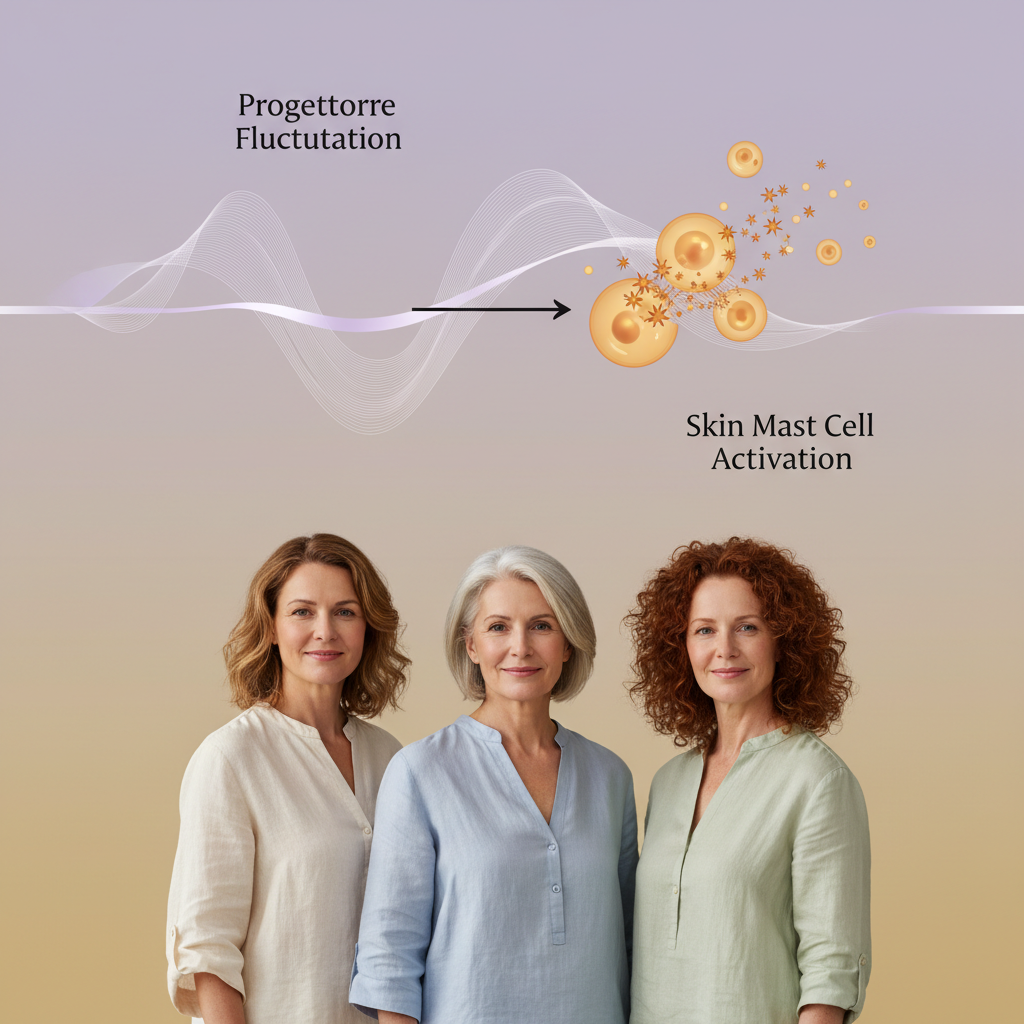
If you have noticed a mysterious rash, hives, or an aggressive breakout that seems to appear exactly three to ten days before your period starts—only to vanish once your flow begins—you aren't imagining things. You might be experiencing a rare but significant condition known as Autoimmune Progesterone Dermatitis (APD).
For many women entering their 40s, these symptoms become more frequent, often leaving them scouring a perimenopause symptoms checklist to understand why their skin is suddenly overreacting to their own biology. While your hormones shift during this transition, your immune system can sometimes perceive your rising progesterone levels as a foreign invader, leading to a literal "allergy" to your own cycle.
What is autoimmune progesterone dermatitis and why does it flare at 40?
Autoimmune Progesterone Dermatitis (APD) is a rare condition where the immune system develops a hypersensitivity to the endogenous progesterone produced by the ovaries. Progesterone typically peaks during the luteal phase (the second half) of your menstrual cycle. According to the National Institutes of Health (NIH), the skin manifestations typically appear cyclically, mirroring this hormonal rise.
Why does this often become an issue or flare up in your 40s? Perimenopause is characterized by "hormonal chaos." While we often think of this stage as a time of declining hormones, it actually involves dramatic fluctuations. During some cycles, you may have "estrogen dominance" followed by a sharp spike or a sudden drop in progesterone. These erratic swings can "prime" the immune system. If you already have a history of conditions like Hashimoto’s or other autoimmune overlaps, your immune system may already be in a state of high alert, making it more likely to react to your own sex steroids.
Moreover, as we age, the skin barrier tends to thin and become more permeable, potentially allowing systemic inflammatory responses to manifest more visibly as dermatological issues.
Why do cyclic skin rashes get worse during perimenopause?
The transition to menopause changes the way our bodies manage inflammation. During perimenopause, the decline in estrogen—which is generally anti-inflammatory—can leave the body more vulnerable to inflammatory flares. Because progesterone levels can fluctuate wildly during this time, the "trigger" for APD becomes less predictable but often more intense.
Research published via PubMed Central suggests that APD can present in various forms, including:
- Urticaria (Hives): The most common presentation.
- Erythema Multiforme: Target-like lesions.
- Eczematoid Dermatitis: Red, itchy, scaly patches.
- Angioedema: Deep swelling of the lips or eyelids.
In your 40s, these rashes often get worse because the body’s stress response (cortisol) is frequently taxed. High stress can exacerbate any autoimmune-mediated condition. This is similar to how women with fibromyalgia and perimenopause symptoms often find their pain flares specifically during their luteal phase when the "protective" effects of stable hormones are absent.
Can you be allergic to your own progesterone in your 40s?
While it sounds like a medical myth, you can indeed be "allergic" to your own progesterone. The clinical term is "hypersensitivity." This usually happens when the body has been exposed to external sources of progesterone (like the birth control pill or a progestin-containing IUD) in the past, or following pregnancy when progesterone levels were exceptionally high. The immune system develops antibodies against the hormone.
The mechanism is often an IgE-mediated response, the same pathway involved in pollen or peanut allergies. When your natural progesterone rises after ovulation, those antibodies trigger mast cells to release histamine, leading to the symptoms of autoimmune progesterone dermatitis symptoms and perimenopause flare-ups.
| Feature | Typical Allergic Reaction | Autoimmune Progesterone Dermatitis |
|---|---|---|
| Trigger | External (Food, Pollen, Pets) | Internal (Endogenous Progesterone) |
| Timing | Immediate upon exposure | 3–10 days before menstruation |
| Resolution | When trigger is removed | 1–2 days after period starts |
| Primary Symptom | Hives, Sneezing, Itching | Hives, Rashes, Cyclic Acne |
| Age of Onset | Any | Puberty to Perimenopause |
How to tell the difference between perimenopause acne and APD?
It is very common for women to mistake APD for standard hormonal acne. However, there are distinct differences.
- The Timing: Perimenopause acne is often persistent or flares slightly before the period but lingers. APD lesions appear almost overnight during the luteal phase and disappear entirely once the period is established and progesterone falls.
- The Sensation: Standard acne might be tender or painful. APD rashes are almost always intensely itchy (pruritic) or produce a burning sensation.
- The Appearance: APD often looks like "welts" or flat, red patches (macules) rather than the deep, cystic bumps typical of hormonal acne.
- Systemic Symptoms: APD can sometimes be accompanied by wheezing or "brain fog," which are also common features of perimenopause insulin resistance and general systemic inflammation.
If you are using a HRT guide for beginners to manage other symptoms, you might notice that starting certain types of HRT makes these "acne" spots much worse, which is a significant clue that the issue is progesterone-specific.
Do progesterone supplements make autoimmune skin conditions worse?
For women with APD, exogenous (outside) progesterone can be like adding fuel to a fire. This creates a difficult situation for perimenopausal women who need progesterone to balance estrogen or protect the uterus while on HRT.
If you have a true progesterone hypersensitivity, taking "natural" micronized progesterone (like Prometrium) or synthetic progestins (like Provera) can trigger a systemic flare. According to the American College of Obstetricians and Gynecologists (ACOG), any patient showing cyclic skin changes should be monitored closely when starting hormonal therapy.
If you suspect you have this condition:
- Avoid Progestin IUDs: These can cause a constant, low-level flare because they release hormones continuously.
- Seek Bioidentical Options: Some women react less to bioidentical progesterone than synthetic versions, but for those with severe APD, even bioidentical versions are triggers.
- Desensitization: In extreme cases, immunologists can perform a desensitization protocol, slowly introducing tiny amounts of the hormone to the body.
What are the best treatments for progesterone-induced rashes?
Managing APD requires a two-pronged approach: suppressing the immune response and stabilizing the hormonal trigger.
- Antihistamines: Second-generation antihistamines (like cetirizine or loratadine) are the first line of defense to manage the itching and hives.
- Topical Corticosteroids: These can help control localized inflammation when the rash appears.
- Inhibition of Ovulation: Since the trigger is the natural rise of progesterone after ovulation, suppressing ovulation can "quiet" the condition. This is often done using GnRH agonists, though this induces a temporary "medical menopause."
- Hormone Stabilization: For some, a low-dose birth control pill that provides a steady level of hormones (rather than the natural peak and trough) can help, though this is risky if the person is highly sensitive to the synthetic progestin in the pill.
- Mast Cell Stabilizers: Some practitioners find success with supplements like Quercetin or medications like Cromolyn sodium, which prevent the release of histamine.
The Mayo Clinic emphasizes that treatment must be individualized, as the severity of the reaction can range from minor annoyance to rare cases of anaphylaxis.
When should you see an immunologist for perimenopause skin flares?
While a dermatologist is often the first stop for a rash, APD is an immunological disorder at its core. You should consider seeing an Allergist or Immunologist if:
- Your "period rashes" are becoming more severe or spreading to more areas of your body.
- You experience any swelling of the throat, difficulty breathing, or dizziness during your luteal phase.
- You have tried standard acne or eczema treatments with zero success.
- You are planning on starting HRT but have a history of reacting poorly to birth control in the past.
A diagnosis is typically confirmed through a skin prick test using a dilute solution of progesterone or an intramuscular injection to observe a local reaction. Because this condition is rare, you may need to advocate for yourself and bring a dairy of your symptoms mapped against your menstrual cycle.
Understanding the link between your hormones and your skin is vital during the perimenopause transition. By recognizing that your "perimenopause flare-ups" might actually be an autoimmune response to progesterone, you can stop treating the surface of your skin and start addressing the underlying immune trigger. Stay curious, track your patterns, and remember that you deserve to feel comfortable in your skin through every phase of your cycle.
FAQ
Common questions
What is autoimmune progesterone dermatitis?
APD is a rare condition where the immune system reacts to the rise of progesterone during the menstrual cycle, causing cyclic skin rashes.
When do the symptoms of APD usually appear?
Typically, symptoms appear 3 to 10 days before your period starts and resolve shortly after your menstrual flow begins.
What are the most common symptoms of progesterone dermatitis?
Common symptoms include hives (urticaria), eczema-like patches, target lesions, and in rare cases, deep swelling or respiratory issues.
How does perimenopause affect APD?
Perimenopause involves intense hormonal fluctuations and a declining immune tolerance, which can trigger or worsen existing sensitivities.
How is autoimmune progesterone dermatitis diagnosed?
A doctor or immunologist can perform a progesterone skin prick test or a controlled provocative challenge to confirm the diagnosis.
Can you treat an allergy to your own hormones?
Treatments include antihistamines, topical steroids, medications that suppress ovulation, and sometimes desensitization therapy.
Want this in your inbox each Sunday?
New articles, the science you can actually use, and the occasional rant.
Keep reading

Perimenopause Symptoms Checklist: 38 Signs You're Not Imagining
A comprehensive, doctor-reviewed checklist of perimenopause symptoms — from the obvious hot flashes to the weird ones nobody warned you about.
9 min read

Hashimoto's and Perimenopause: Why Symptoms Overlap (and How to Tell Them Apart)
Fatigue, brain fog, weight gain, hair loss — Hashimoto's and perimenopause share most symptoms. Here's how to tell what's flaring, what's hormonal, and what to ask your doctor.
11 min read

Fibromyalgia and Perimenopause: When Two Storms Collide
Why fibromyalgia almost always flares during perimenopause, what changes in your nervous system, and the small daily shifts that actually help.
10 min read