
Behçet’s Disease vs. Perimenopause: Overlapping Symptoms
Explore the differences between Behçet’s disease symptoms in women vs. perimenopause, from mouth sores to joint pain, and how to manage these overlapping signs.
Published:
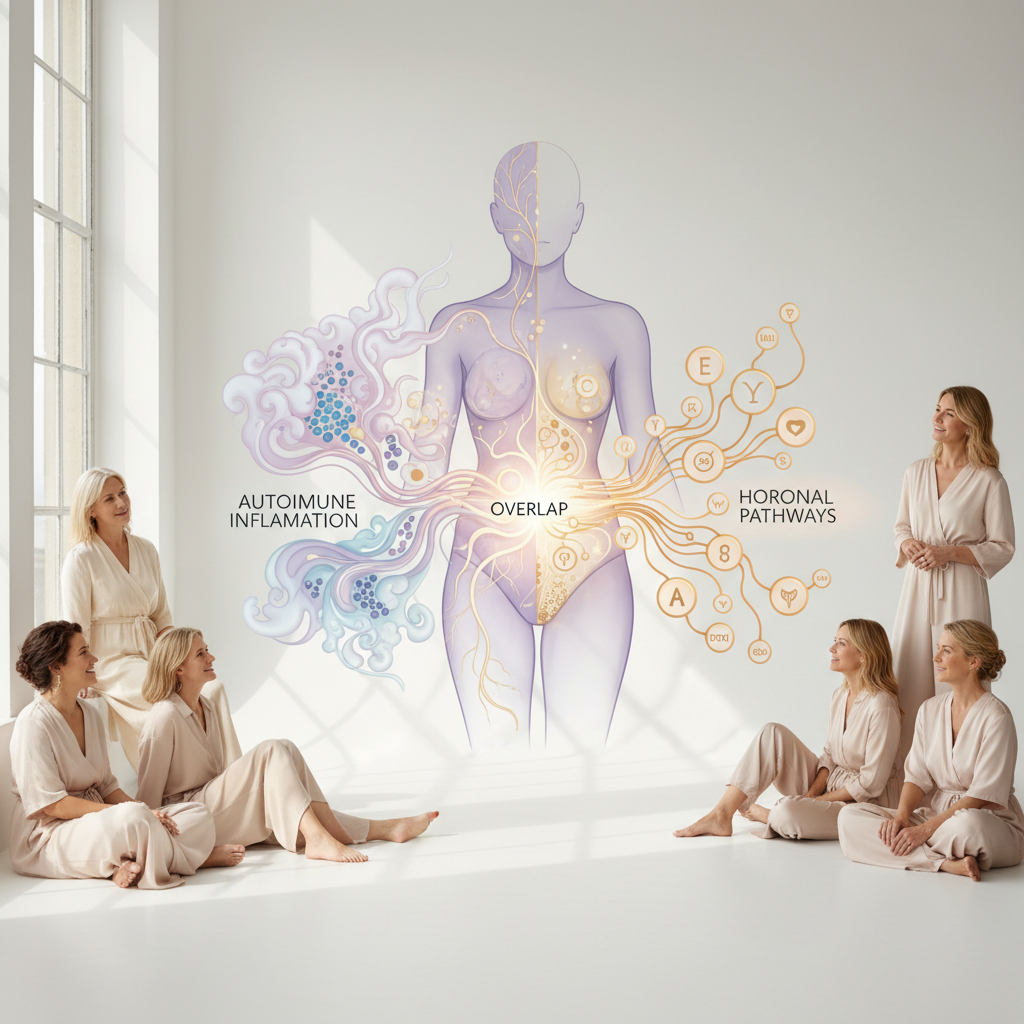
Navigating your 40s and 50s often feels like a masterclass in decoding your own body. You might find yourself staring in the mirror, wondering if those recurrent mouth sores or that deep, aching exhaustion are "just" perimenopause or something more systemic. For women living with Behçet’s Disease—a rare, chronic condition that causes blood vessel inflammation throughout the body—the transition into perimenopause can feel like a collision of two very different, yet confusingly similar, clinical worlds.
Understanding the difference between Behçet’s disease symptoms in women vs. perimenopause is crucial for ensuring you get the right treatment. While perimenopause is a natural hormonal transition, Behçet’s is an autoimmune-mediated vasculitis. When these two overlap, the symptoms can mimic one another, leading to delayed diagnoses or undertreated flares.
What are the unique signs of Behçet’s disease in women over 40?
Behçet’s disease is characterized by a "triple-symptom complex" of recurrent oral ulcers, genital ulcers, and uveitis (eye inflammation). However, for women reaching the perimenopausal window, the presentation can be more nuanced. According to the National Institutes of Health (NIH), Behçet’s is a systemic vasculitis, meaning it involves the inflammation of blood vessels of all sizes.
In women over 40, the unique signs of Behçet’s often include:
- Recurrent Genital Ulcers: Unlike the vaginal dryness or irritation common in perimenopause, Behçet’s causes painful, open sores that may scar.
- Skin Lesions: These often appear as erythema nodosum (painful, red nodules usually on the shins) or acne-like rashes that appear even if you never had adult acne.
- Eye Inflammation: Blurred vision, redness, and pain (uveitis) are hallmark signs that are absent in standard perimenopause.
- Neurological Involvement: Known as "Neuro-Behçet’s," this can cause headaches or "brain fog" that feels significantly more debilitating than standard hormonal cognitive shifts.
If you are tracking your symptoms using a perimenopause symptoms checklist, pay close attention to whether your symptoms involve mucosal surfaces (eyes, mouth, genitals) or visible skin inflammation, as these are strong indicators of an underlying autoimmune process.
How do Behçet’s mouth sores differ from perimenopause changes?
Mouth changes are common in both conditions, but their root causes and appearances differ significantly. In perimenopause, declining estrogen levels can lead to "Burning Mouth Syndrome" or generalized dry mouth (xerostomia). This might make your gums feel sensitive or your tongue feel scalded.
In contrast, Behçet’s disease causes aphthous ulcers—classic "canker sores"—but with a frequency and severity that far exceeds the occasional bite of the cheek. According to the American College of Rheumatology, oral ulcers are the initial symptom in roughly 75% to 90% of patients.
| Feature | Perimenopause Mouth Changes | Behçet’s Disease Mouth Sores |
|---|---|---|
| Primary Sensation | Burning, dryness, metallic taste | Intense pain, localized stinging |
| Appearance | Red, thin tissues; no open sores | Round, white/yellow ulcers with red halos |
| Frequency | Constant or cyclical with cycle | Recurrent "crops" (3 or more at once) |
| Location | Tongue, roof of mouth, gums | Inside lips, cheeks, throat |
| Healing Time | Resolves with hydration/estrogen | 7–21 days; often leaves scarring |
Distinguishing between these is vital. If you find that "dryness" treatments like biotene or hormone replacement therapy don't resolve the ulcers, you may be dealing with the systemic inflammation of Behçet’s.
Can perimenopause hormone shifts trigger a Behçet’s flare?
Research suggests a complex relationship between sex hormones and autoimmune activity. Estrogen is known to be immunomodulatory; it can both suppress and stimulate immune responses depending on its concentration. During perimenopause, the dramatic fluctuations in estrogen can act as a physiological stressor.
Much like how Hashimoto’s and perimenopause overlap, the inflammatory pathways in Behçet’s are sensitive to the endocrine environment. Many women report that their Behçet’s flares align with their menstrual cycles (catamenial flares), often worsening in the luteal phase when progesterone rises and estrogen drops.
As you enter perimenopause and those estrogen drops become more frequent and unpredictable, you may experience:
- Increased frequency of oral and genital ulcers.
- Heightened joint sensitivity.
- Worsening of "Behçet’s fatigue," which is deeper and more "flu-like" than the tired feeling associated with poor sleep in perimenopause.
The Mayo Clinic notes that while the exact cause of Behçet’s is unknown, an overactive immune response is likely triggered by environmental factors in genetically predisposed people. Perimenopausal hormonal chaos can certainly serve as one of those environmental triggers.
Is it Behçet’s joint pain or perimenopause estrogen loss?
Joint pain (arthralgia) is a hallmark of the "menopause transition" for about 50% of women. Estrogen helps maintain cartilage health and acts as a mild anti-inflammatory in the joints. When it disappears, joints can feel stiff and achy, particularly in the morning.
However, Behçet’s disease can cause actual arthritis—inflammation of the joint—rather than just "aches."
- The Perimenopause Pattern: Usually affects the fingers, wrists, and knees. It is often described as a dull ache that improves with movement and HRT for perimenopause.
- The Behçet’s Pattern: Usually non-deforming but can cause visible swelling, redness, and heat in the ankles, knees, wrists, or elbows. According to the Cleveland Clinic, joint involvement occurs in about 50% of people with the condition.
If your joint pain is accompanied by swelling or skin rashes, the cause is likely inflammatory (Behçet’s) rather than purely hormonal. This nuance is critical because treating inflammatory arthritis with just "menopause supplements" will not prevent potential joint damage.
How do doctors distinguish between systemic inflammation and hormones?
Diagnosing Behçet’s during perimenopause is challenging because there is no single "Behçet’s test." Instead, doctors use the International Study Group criteria.
To distinguish between the two, your medical team—ideally a rheumatologist and a gynecologist—will look for:
- Pathergy Test: A unique test for Behçet’s where a small needle prick is made on the forearm. If a bump or pustule forms within 48 hours, it indicates an overactive immune response. This is not affected by perimenopause.
- Inflammatory Markers: Blood tests such as C-reactive protein (CRP) and Erythrocyte Sedimentation Rate (ESR) are often elevated during a Behçet’s flare. While perimenopause can slightly elevate CRP due to insulin resistance signs, massive spikes usually point to an autoimmune condition.
- Response to Treatment: If symptoms like joint pain and fatigue only respond to Prednisone or immunosuppressants, and not to hormone therapy, a Behçet’s diagnosis becomes more likely.
It is also common for women to have both. In fact, the chronic stress of an autoimmune disease can sometimes lead to an earlier onset of perimenopausal symptoms. Similar to the way fibromyalgia and perimenopause symptoms interact, the two conditions can create a "feedback loop" of pain and fatigue.
What treatments work for both autoimmune flares and hormone shifts?
When you are managing both Behçet’s and perimenopause, your treatment plan must be multi-pronged. You cannot treat one while ignoring the other, as the symptoms will continue to aggravate each other.
- Hormone Replacement Therapy (HRT): For many women, stabilizing estrogen levels through HRT can reduce the frequency of hormone-triggered Behçet’s flares. By keeping the "internal environment" steady, the immune system may be less reactive.
- Colchicine: This is often the first-line treatment for Behçet’s oral and genital sores. It works by inhibiting the migration of neutrophils (white blood cells) to the site of inflammation.
- TNF Inhibitors: For severe systemic Behçet’s, biologic medications like adalimumab or infliximab may be necessary. These target specific inflammatory proteins.
- Anti-Inflammatory Diet: While not a cure, reducing systemic inflammation through a Mediterranean-style diet can help manage the metabolic shifts of perimenopause and the inflammatory burden of Behçet’s.
- Vaginal Estrogen: This can help differentiate between perimenopausal tissue thinning (atrophy) and Behçet’s ulcers. If the tissue heals with topical estrogen, the cause was likely hormonal.
Managing "Behçet’s disease symptoms in women vs. perimenopause" requires a patient-centered approach where your subjective experience of pain and fatigue is taken seriously. You are the expert on your body; if your "hot flashes" come with a fever, or your "dry mouth" comes with bleeding sores, do not hesitate to ask for a referral to a rheumatologist. By addressing both the hormonal and the autoimmune components, you can reclaim your quality of life and navigate your second spring with radiance.
FAQ
Common questions
How can I tell if my mouth sores are Behçet’s or just perimenopause?
Behçet’s sores are typically painful, well-defined ulcers with a yellow center, whereas perimenopause mouth changes often manifest as a generalized burning sensation or dry mouth without open wounds.
Can perimenopause make Behçet’s symptoms worse?
Yes, the dramatic drop and fluctuation in estrogen during perimenopause can trigger the immune system, potentially leading to more frequent Behçet’s flares.
Is my joint pain caused by inflammation or low estrogen?
Behçet’s joint pain often involves visible swelling and redness in specific joints like the ankles or knees, while perimenopause joint pain is usually a generalized morning stiffness or dull ache.
What is the Pathergy test and why does it matter?
A Pathergy test is a skin prick test where a small bump forming indicates an overactive immune response typical of Behçet’s; it is not a test for perimenopause.
Are genital ulcers common in perimenopause?
Genital ulcers are a hallmark of Behçet’s and are quite painful, while perimenopause usually causes thinning of the tissue, dryness, and irritation rather than deep sores.
Can I use HRT if I have Behçet’s disease?
A combination of HRT to stabilize hormones and medications like colchicine or biologics to control Behçet’s inflammation is often the most effective approach.
Want this in your inbox each Sunday?
New articles, the science you can actually use, and the occasional rant.
Keep reading

Perimenopause Symptoms Checklist: 38 Signs You're Not Imagining
A comprehensive, doctor-reviewed checklist of perimenopause symptoms — from the obvious hot flashes to the weird ones nobody warned you about.
9 min read

Hashimoto's and Perimenopause: Why Symptoms Overlap (and How to Tell Them Apart)
Fatigue, brain fog, weight gain, hair loss — Hashimoto's and perimenopause share most symptoms. Here's how to tell what's flaring, what's hormonal, and what to ask your doctor.
11 min read

Fibromyalgia and Perimenopause: When Two Storms Collide
Why fibromyalgia almost always flares during perimenopause, what changes in your nervous system, and the small daily shifts that actually help.
10 min read