
Hashimoto's Flare or Perimenopause? How to Tell the Difference
Distinguishing between a Hashimoto's flare and perimenopause is tricky. Learn the symptom overlaps, the 'estrogen trap' in thyroid testing, and the labs you actually need.
Published:
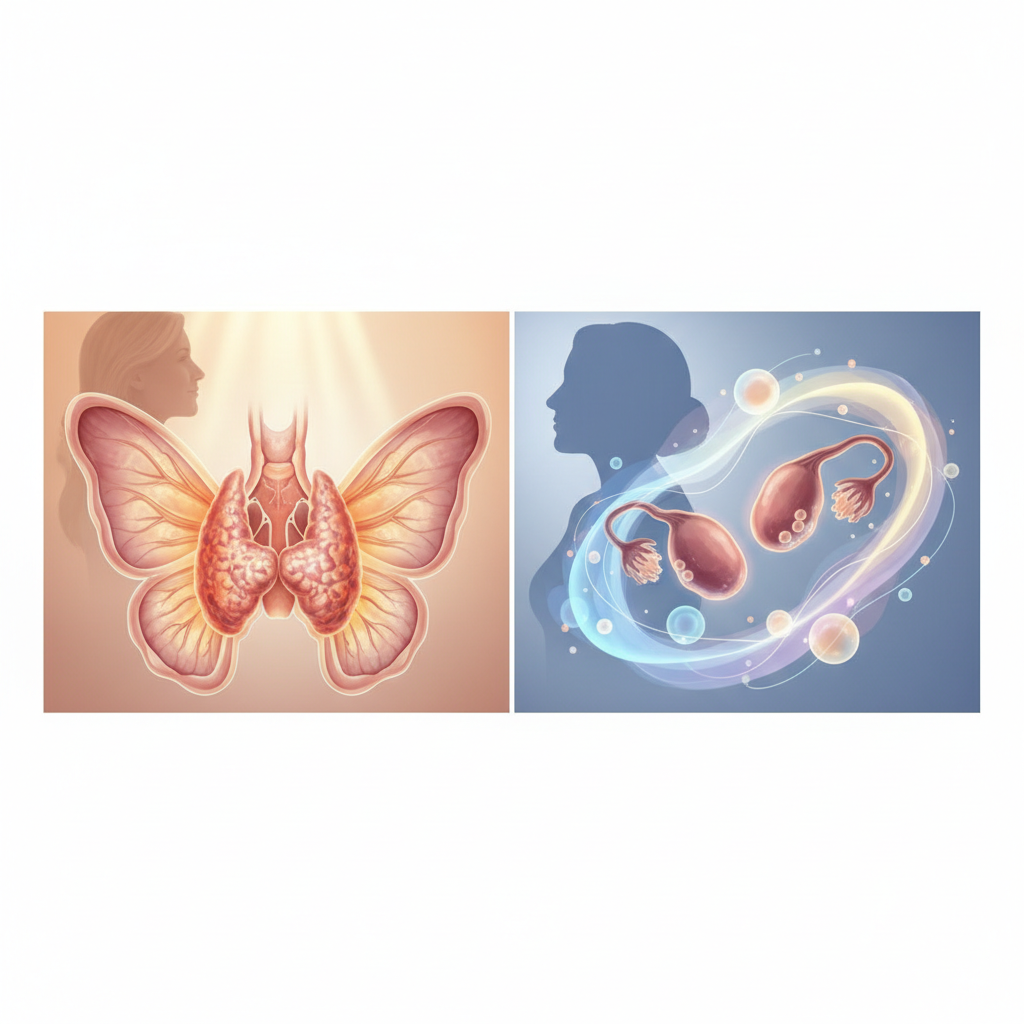
You’re exhausted, your skin feels like parchment, and your favorite jeans suddenly won’t zip. You might head to your doctor thinking it’s your thyroid, only to be told your labs are "normal." Or perhaps you’ve lived with Hashimoto’s for years, but suddenly your usual dose of levothyroxine isn't touching the brain fog.
This is the "Twilight Zone" of midlife health: the overlapping territory of Hashimoto’s thyroiditis and perimenopause. Because both conditions can cause weight gain, fatigue, and mood swings, it is incredibly easy to misdiagnose one for the other—or to ignore the fact that both are happening simultaneously.
Understanding the distinction is critical because treating a thyroid flare with more hormones won't fix an estrogen deficiency, and vice versa. Let's look at how to untangle these two hormonal heavyweights.
Why do symptoms overlap so closely?
Hashimoto’s is an autoimmune condition where your immune system attacks the thyroid gland, leading to hypothyroidism. Perimenopause is the transitional phase leading to menopause, characterized by fluctuating (and eventually declining) estrogen and progesterone.
Despite being different systems—the endocrine system’s thyroid axis versus the reproductive axis—they share the same "zip code" in the brain (the hypothalamus and pituitary glands). When one fluctuates, it often pulls the other with it.
Symptom Overlap Chart
| Symptom | Hashimoto's Flare | Perimenopause | Both |
|---|---|---|---|
| Fatigue | "Heavy" limbs, wanting to nap all day | Wired but tired, insomnia-related | Yes |
| Weight | Sudden gain, fluid retention (myxedema) | Abdominal "visceral" fat shift | Yes |
| Temperature | Cold intolerance (always freezing) | Hot flashes and night sweats | Yes |
| Cycle Changes | Very heavy or frequent periods | Irregular, skipped, or spotting | Yes |
| Mood | Apathy, depression, "flatness" | Irritability, rage, anxiety | Yes |
| Brain Fog | Slow processing, forgetfulness | Word-finding difficulty | Yes |
| Hair/Skin | Loss of outer eyebrow, very dry skin | Thinning hair, loss of elasticity | Yes |
As you can see, the Hashimoto's and perimenopause overlap is significant. However, a key differentiator is often the nature of the temperature dysregulation. Hashimoto’s usually makes you feel chilled to the bone, while perimenopause is famous for the sudden "internal furnace" of a hot flash.
Why does TSH alone miss both conditions?
If you suspect something is wrong, your GP will likely run a TSH (Thyroid Stimulating Hormone) test. While this is the "gold standard" screening tool, it is notoriously insufficient for women in midlife for two reasons.
- The "Normal" Range is Too Wide: Most labs cite a "normal" TSH up to 4.5 or 5.0 mIU/L. However, many women feel symptomatic once their TSH climbs above 2.5. According to the American Thyroid Association, TSH only measures the pituitary's signal to the thyroid, not the actual hormones (T4 and T3) available to your cells.
- Perimenopausal Fluctuations: Estrogen levels during perimenopause can swing wildly from one day to the next. High estrogen can artificially suppress TSH or mask symptoms of a struggling thyroid, leaving you with "normal" labs while you feel miserable.
If you are only getting a TSH test, you are missing half the story. You can read more about broad symptom tracking in our perimenopause symptoms checklist.
What is the estrogen-thyroid binding globulin trap?
This is the physiological "glitch" that confuses even seasoned clinicians. Your body produces a protein called Thyroid Binding Globulin (TBG). Think of TBG as a bus that carries thyroid hormone through your bloodstream. While the hormone is on the bus, it is "bound" and cannot be used by your cells. Only "Free" T4 and "Free" T3 can actually do the work of metabolism and energy production.
Here is the trap: High levels of estrogen (common in early perimenopause or if you are on certain types of oral HRT) increase the production of TBG.
- More TBG = More "buses" on the road.
- More "buses" = More thyroid hormone getting "stuck" on the bus.
- The result: Your Total T4 might look great, but your Free T4 is tanking.
This is why many women experience a Hashimoto’s flare-up exactly when their estrogen peaks. Conversely, when estrogen drops sharply in late perimenopause, you may suddenly become sensitive to your thyroid medication because there is less TBG to soak it up. This delicate dance is why HRT for perimenopause beginners must be managed alongside thyroid labs.
Which antibody testing actually helps?
If you suspect Hashimoto’s, you must look beyond TSH and T4. Hashimoto’s is an autoimmune disease, meaning the problem isn't just the thyroid; it’s the immune system.
You should request the following "Full Thyroid Panel":
- TPO Antibodies (Thyroid Peroxidase): High levels indicate an active immune attack on the thyroid.
- TgAb (Thyroglobulin Antibodies): Another marker of autoimmune activity.
- Free T3: The active hormone that fuels your brain and metabolism.
- Reverse T3: A "brake" your body pulls when it’s under stress (like the stress of perimenopause).
The National Institutes of Health (NIH) notes that you can have elevated antibodies for years before your TSH ever goes "out of range." If your antibodies are high, you have Hashimoto's, even if your TSH is currently 1.5. This knowledge allows you to address inflammation through diet and lifestyle before the thyroid is permanently damaged.
How do I track my cycle alongside thyroid labs?
Because of the TBG trap mentioned above, when you get your blood drawn matters immensely. If you are still cycling, your estrogen levels peak around ovulation and again during the mid-luteal phase.
To get the most accurate picture of your "baseline," follow these steps:
- Test during Days 2–5: Aim to have your blood drawn during the first few days of your period when estrogen is at its lowest.
- Fast Beforehand: Most endocrinologists recommend fasting for thyroid labs to avoid interference from lipids or glucose.
- Skip the Biotin: Many "hair, skin, and nails" supplements contain high doses of Biotin (B7), which can falsely lower TSH and falsely elevate T4/T3. Stop taking Biotin at least 3-5 days before testing.
- Log Your Symptoms Daily: Use a dedicated app or notebook to track "Thyroid Days" (heavy limbs, cold) vs. "Perimenopause Days" (hot flashes, night sweats).
If you are dealing with widespread pain alongside these symptoms, you may also want to investigate the fibromyalgia-perimenopause connection, as autoimmune markers and hormonal dips can trigger systemic pain.
When is it time to push for a specialist?
Most primary care physicians are trained to treat "the numbers," not the patient. If your doctor tells you that you are "fine" because your TSH is 4.2, but you are losing your hair and can't get out of bed, it is time to advocate for yourself.
Seek a specialist (Endocrinologist or Functional Medicine MD) if:
- Your TSH is "stable" but your symptoms are worsening.
- You have a family history of autoimmune disease (RA, Celiac, Lupus).
- You are experiencing signs of perimenopausal insulin resistance, such as rapid weight gain around the middle despite no change in diet.
- You have been on thyroid medication for years but suddenly feel "over-medicated" (palpitations, anxiety) as your cycles change.
Summary Checklist for Your Next Appointment
- Ask for "Free T3, Free T4, TPO, and TgAb" specifically.
- Discuss your cycle regularity (or lack thereof).
- Mention night sweats versus general cold intolerance.
- Request a Vitamin D and Ferritin (iron storage) check, as deficiencies in these mimick both Hashimoto's and perimenopause.
The unruly years of midlife require a nuanced approach. You are not a single lab value; you are a complex system of interlocking hormones. By untangling the thyroid from the ovaries, you can finally find the targeted treatment you deserve.
FAQ
Common questions
How can I tell if my chills are thyroid-related or perimenopause?
While Hashimoto's causes general cold intolerance, perimenopause is categorized by sudden, intense bursts of heat (hot flashes) followed by chills.
Can perimenopause trigger a Hashimoto's flare?
Yes. Perimenopausal estrogen fluctuations can change the level of Thyroid Binding Globulin (TBG) in your blood, making your existing thyroid condition feel worse or more erratic.
What thyroid tests should I ask for if TSH is normal?
A full panel should include TSH, Free T4, Free T3, TPO Antibodies, and TgAb Antibodies. Testing TSH alone is often insufficient for women in midlife.
Are there specific symptoms that only belong to Hashimoto’s?
A key sign of Hashimoto's is the loss of the outer third of the eyebrows and very sluggish digestion (constipation). Perimenopause is more likely to cause 'word-finding' brain fog and night sweats.
Does Biotin affect my thyroid test results?
Biotin (Vitamin B7) found in many hair and nail supplements can interfere with thyroid lab results. Stop taking it at least 72 hours before your blood draw.
Want this in your inbox each Sunday?
New articles, the science you can actually use, and the occasional rant.
Keep reading

Perimenopause Symptoms Checklist: 38 Signs You're Not Imagining
A comprehensive, doctor-reviewed checklist of perimenopause symptoms — from the obvious hot flashes to the weird ones nobody warned you about.
9 min read

Hashimoto's and Perimenopause: Why Symptoms Overlap (and How to Tell Them Apart)
Fatigue, brain fog, weight gain, hair loss — Hashimoto's and perimenopause share most symptoms. Here's how to tell what's flaring, what's hormonal, and what to ask your doctor.
11 min read

Fibromyalgia and Perimenopause: When Two Storms Collide
Why fibromyalgia almost always flares during perimenopause, what changes in your nervous system, and the small daily shifts that actually help.
10 min read