
Scleroderma or Perimenopause? Decoding Aches After 40
Is it just perimenopause joint pain or early scleroderma? Learn to decode skin thickening, Raynaud's, and stiffness in your 40s with our expert guide.
Published:
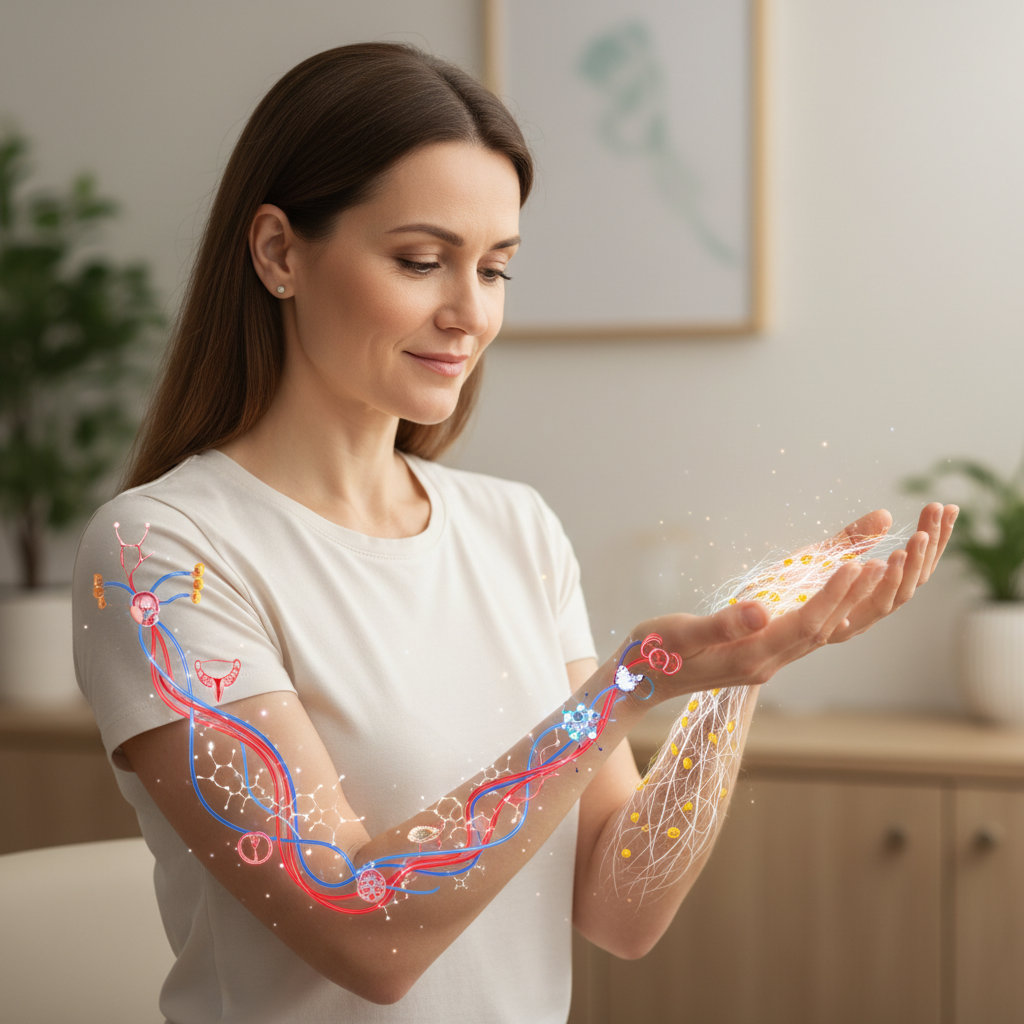
Entering your 40s brings a host of physiological transitions, but when you wake up with stiff joints, swollen fingers, and a strange sensitivity to cold, you might wonder if your hormones are to blame or if something more systemic is occurring. For many women, the lines between "the change" and autoimmune conditions like scleroderma (systemic sclerosis) become dangerously blurred.
Scleroderma is a rare connective tissue disease characterized by the overproduction of collagen, leading to skin thickening and potential internal organ involvement. Because its peak onset often occurs between ages 30 and 50, its initial presentation frequently overlaps with the onset of perimenopause. Understanding the nuance between these two conditions is vital for ensuring you receive the correct treatment—whether that involves hormone replacement therapy or immunosuppressive management.
Is it perimenopause joint pain or early signs of scleroderma?
In your 40s, estrogen levels begin to fluctuate and eventually decline, which can lead to significant musculoskeletal discomfort. Estrogen has a protective effect on joints and cartilage; when it drops, inflammation can increase, leading to the classic perimenopause symptoms checklist many women experience.
However, scleroderma joint pain typically presents with a distinct "tightness." While perimenopausal joint pain often feels like a dull ache or stiffness that improves with movement, scleroderma-related pain is frequently associated with skin that feels too small for the body. According to the American College of Rheumatology, systemic sclerosis involves an overactive immune system that attacks healthy tissue, causing scarring and thickening.
Distinguishing the two requires looking at the "quality" of the pain. Perimenopause may cause migratory joint pain—today it’s the knee, tomorrow the wrist—whereas scleroderma often presents symmetrically in the small joints of the hands and feet, accompanied by visible changes in skin texture. If you are also managing other conditions, such as fibromyalgia perimenopause symptoms, the diagnostic process can be even more complex, as central sensitization can heighten the perception of both hormonal and autoimmune pain.
Why does skin tightening and Raynaud's happen in your 40s?
One of the hallmark signs of scleroderma is Raynaud’s phenomenon—a condition where fingers or toes turn white, blue, and then red in response to cold or stress. While Raynaud's can exist on its own (Primary Raynaud's), its sudden onset in your 40s is often a "red flag" for connective tissue disease.
| Symptom | Perimenopause Presentation | Scleroderma Presentation |
|---|---|---|
| Skin Changes | Dryness, loss of elasticity, "crepey" texture. | Thickening, tightening, "shiny" appearance. |
| Raynaud's | Rare, though cold sensitivity may increase. | Very common; often the first clinical sign. |
| Joint Stiffness | Worse in the morning; improves with movement. | Persistent; accompanied by skin tethering. |
| Fatigue | Linked to sleep disturbances/night sweats. | Profound, systemic inflammatory exhaustion. |
| Digital Ulcers | None. | Small, painful sores on fingertips. |
The skin tightening in scleroderma (sclerodactyly) usually begins in the fingers. You might notice that you can no longer "pinch" the skin on the back of your hand. In contrast, perimenopausal skin changes are usually related to a loss of collagen and hydration, making the skin thinner rather than thicker. The Mayo Clinic notes that scleroderma skin changes can also involve the face, making it difficult to open the mouth wide—a symptom never associated with standard perimenopause.
How does declining estrogen affect connective tissue disease flares?
Estrogen is a potent immunomodulator. Research suggests that the dramatic drop in estrogen during the perimenopausal transition can act as a "trigger" or an "accelerant" for autoimmune flares. This is why many women are diagnosed with conditions like scleroderma or Hashimoto's and perimenopause overlap during their late 40s.
When estrogen levels are low, the body’s inflammatory cytokine profile changes. For women already living with subclinical scleroderma, this hormonal shift can move the disease from a "smoldering" state to an active flare. Furthermore, the loss of estrogen affects the microvasculature. Since scleroderma is fundamentally a disease of the blood vessels and connective tissue, the vascular instability of perimenopause (which causes hot flashes) can exacerbate the vascular spasms of Raynaud’s.
For some, HRT for perimenopause beginners guide may offer some relief by stabilizing the vascular system and reducing systemic inflammation, but it is not a treatment for the underlying fibrotic process of scleroderma. It is essential to work with both a gynecologist and a rheumatologist to manage this delicate balance.
Can perimenopause cause systemic sclerosis-like digestive issues?
Both perimenopause and scleroderma can wreak havoc on your digestive system, but the mechanisms differ significantly. In perimenopause, shifting hormones affect gut motility, often leading to bloating, constipation, or new food sensitivities. This is sometimes linked to perimenopause insulin resistance signs, which can further alter metabolic health.
In scleroderma, the digestive issues are caused by "hypomotility" due to fibrosis (scarring) of the esophageal and intestinal muscles. According to the National Institutes of Health (NIH), upwards of 90% of people with systemic sclerosis experience gastrointestinal symptoms.
- Esophageal Dysfunction: Severe acid reflux (GERD) that doesn't respond to standard over-the-counter antacids is a major scleroderma indicator. In perimenopause, reflux is usually milder and linked to specific triggers.
- Pseudo-obstruction: Scleroderma can cause the intestines to stop moving effectively, leading to severe bloating and pain that mimics a bowel obstruction.
- Malabsorption: Because the gut wall thickens, the body may struggle to absorb nutrients, leading to unexplained weight loss—whereas perimenopause is more commonly associated with weight gain.
What blood tests differentiate autoimmune scleroderma from hormonal shifts?
Because the symptoms of fatigue and joint pain are so non-specific, blood work is your most powerful tool for decoding what is happening in your body. If you suspect your "perimenopause" is actually scleroderma, you must request specific serology beyond standard hormone panels (FSH/LH/Estradiol).
- ANA (Antinuclear Antibody) with Titer and Pattern: Most scleroderma patients (about 95%) will test positive for ANA. However, a "weak" positive can sometimes occur in healthy aging women or those with thyroid issues.
- Scleroderma-Specific Antibodies: Tests for Anti-Scl-70 (topoisomerase I), Anti-Centromere, and Anti-RNA Polymerase III are highly specific for scleroderma.
- Nailfold Capillaroscopy: This is not a blood test, but a simple bedside procedure where a rheumatologist looks at the capillaries at the base of your fingernails under a microscope. Distorted or "dropout" loops are a definitive sign of systemic sclerosis.
- Inflammatory Markers: CRP (C-Reactive Protein) and ESR (Sedentary Rate) may be elevated in both conditions but are typically higher in active autoimmune states.
According to the Cleveland Clinic, early diagnosis is crucial because systemic sclerosis can affect the lungs and heart. If your "menopause" symptoms include shortness of breath or a dry cough, you need a pulmonary function test (PFT) and an echocardiogram immediately.
Why are my hands stiff and swollen every morning after 40?
Morning stiffness is a classic complaint of women in their 40s. In perimenopause, this is often "gel phenomenon"—where the joints feel stiff after inactivity but loosen up within 15–30 minutes of moving around.
In early scleroderma, the swelling is often described as "puffy hands" (edematous phase). Your fingers might look like sausages, and the skin may feel tight and itchy. This swelling is caused by excess collagen being deposited into the extracellular matrix and inflammation of the tenders. Unlike perimenopausal stiffness, scleroderma puffiness often lasts throughout the day and does not fully resolve with morning movement.
Furthermore, if this stiffness is accompanied by "telangiectasia"—small, red, mat-like spots on the face or hands caused by dilated blood vessels—it points strongly toward a systemic autoimmune process rather than purely hormonal fluctuations. The National Institute of Arthritis and Musculoskeletal and Skin Diseases emphasizes that detecting these vascular changes early can prevent long-term tissue damage.
How to manage overlapping scleroderma and perimenopause symptoms?
Managing both conditions requires a "biopsychosocial" approach. You are not just treating a hormone deficiency or an autoimmune disease; you are treating a whole person whose systems are deeply interconnected.
- Vascular Protection: If you have Raynaud's and perimenopausal hot flashes, avoid "cold shocks." Keep your core temperature stable. Some calcium channel blockers used for Raynaud's can also help with certain types of menopausal palpitations, but should be managed by a physician.
- Anti-Inflammatory Nutrition: Focus on a Mediterranean-style diet. Reducing processed sugars can help mitigate both perimenopause insulin resistance and the systemic inflammation that drives scleroderma.
- Skin Care: For perimenopause, you need hydration and oils. For scleroderma, you need medically-directed stretches to maintain range of motion in the skin and joints, along with heavy-duty emollients to prevent cracking.
- Stress Management: Stress triggers both cortisol spikes (bad for perimenopause) and vasospasms (bad for scleroderma). Practices like Yoga Nidra or acupuncture have been shown to help calm the autonomic nervous system.
- Professional Collaboration: Ensure your Rheumatologist and your NAMS-certified Menopause Specialist are in communication. Some immunosuppressants used for scleroderma can affect ovarian function, potentially worsening menopausal symptoms.
By being proactive and "decoding" these signals early, you can take control of your health. Whether it’s the transition of perimenopause or the challenge of scleroderma, you deserve a medical team that looks beneath the surface of "aching after 40."
Disclaimer: This article is for informational purposes only and does not constitute medical advice. Always consult with a qualified healthcare provider for diagnosis and treatment of autoimmune conditions or hormonal changes. Regardless of your age, new-onset Raynaud's or skin thickening requires immediate medical evaluation.
FAQ
Common questions
How can I tell the difference between perimenopause joint pain and scleroderma?
Perimenopause joint pain is typically a dull ache that improves with movement. Scleroderma involves skin tightening, 'puffy' fingers, and Raynaud's (fingers turning white/blue in the cold), which are not standard menopause symptoms.
Can perimenopause make scleroderma symptoms worse?
Yes. Declining estrogen levels can increase systemic inflammation and vascular sensitivity, which may worsen Raynaud's phenomenon and skin symptoms in women with scleroderma.
Is Raynaud's phenomenon a normal part of aging or menopause?
Raynaud's is highly associated with scleroderma (occurring in over 90% of cases). While some women feel colder during perimenopause, distinct color changes (white to blue to red) in the fingers are a red flag for autoimmune issues.
What tests should I ask for if I suspect scleroderma?
Initial tests include an ANA (Antinuclear Antibody) with a titer and pattern, along with specific antibodies like Anti-Scl-70 and Anti-Centromere. A nailfold capillaroscopy is also a key diagnostic tool.
Can scleroderma cause the same bloating as perimenopause?
Scleroderma can cause 'puffy hands' and esophageal dysfunction (severe reflux). If your bloating is accompanied by difficulty swallowing or skin that feels 'too tight,' consult a rheumatologist.
Does Hormone Replacement Therapy (HRT) help with scleroderma symptoms?
HRT can help with joint aches and vascular stability related to menopause, but it is not a treatment for scleroderma. However, stabilizing hormones may improve overall quality of life and reduce 'pseudo-flares.'
Want this in your inbox each Sunday?
New articles, the science you can actually use, and the occasional rant.
Keep reading

Perimenopause Symptoms Checklist: 38 Signs You're Not Imagining
A comprehensive, doctor-reviewed checklist of perimenopause symptoms — from the obvious hot flashes to the weird ones nobody warned you about.
9 min read

Hashimoto's and Perimenopause: Why Symptoms Overlap (and How to Tell Them Apart)
Fatigue, brain fog, weight gain, hair loss — Hashimoto's and perimenopause share most symptoms. Here's how to tell what's flaring, what's hormonal, and what to ask your doctor.
11 min read

Fibromyalgia and Perimenopause: When Two Storms Collide
Why fibromyalgia almost always flares during perimenopause, what changes in your nervous system, and the small daily shifts that actually help.
10 min read