
Estrogen Patch vs Pill: Which HRT Is Safer?
A comprehensive guide comparing the safety of estrogen patches versus pills for HRT, focusing on blood clot risks, migraines, and liver health.
Published:
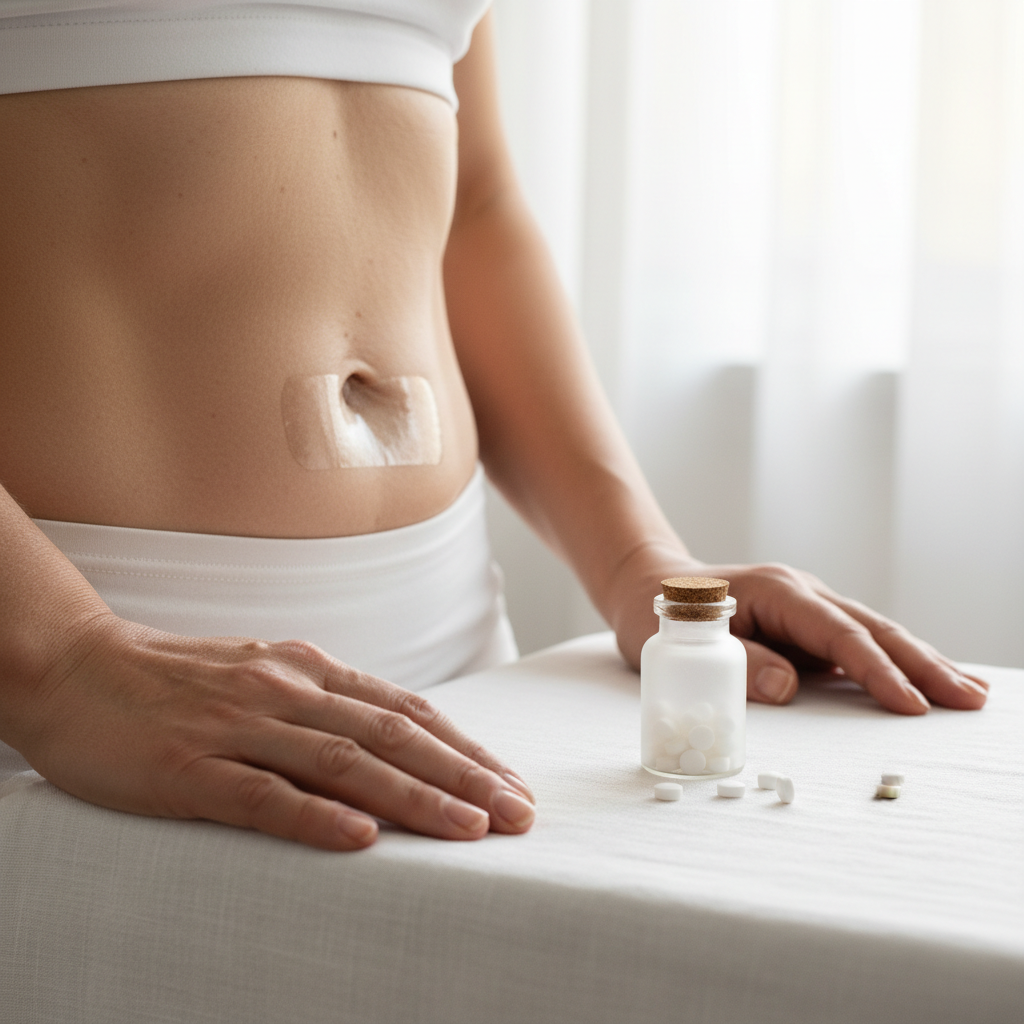
When you first sit down with a provider to discuss Hormone Replacement Therapy (HRT), the conversation usually starts with if you should take it. But once you’ve decided to move forward, the most critical question becomes how you take it.
The route of delivery—whether you swallow a pill or stick a patch to your skin—isn't just a matter of convenience. It fundamentally changes how your body processes the hormones and, more importantly, it shifts your profile for specific medical risks. Understanding the nuances of the estrogen patch vs. pill safety debate is essential for advocating for the treatment that fits your unique health history.
Why does the route of delivery matter for HRT?
When you take an oral estrogen pill, it must travel through your digestive system. From your stomach, it is absorbed into the bloodstream and sent directly to the liver. This is known as "first-pass metabolism." Your liver is an incredibly active organ; when it encounters a surge of oral estrogen, it reacts by changing the production of various proteins, including clotting factors and inflammatory markers.
Transdermal estrogen (the patch, as well as gels and sprays) bypasses the digestive tract and the liver entirely. The hormone is absorbed directly through the skin into the systemic circulation. Because the liver isn't "flooded" with the hormone all at once, those secondary changes to clotting factors don't occur in the same way.
Is there a difference in blood clot risk?
This is the most significant safety distinction between the two formats. Multiple large-scale studies have demonstrated that oral estrogen increases the risk of venous thromboembolism (VTE), which includes deep vein thrombosis (DVT) and pulmonary embolisms.
According to a landmark study published in the British Medical Journal (BMJ), women using oral HRT had a significantly higher risk of VTE compared to those not using HRT. Conversely, the same study found that transdermal estrogen (the patch) was not associated with an increased risk of blood clots.
| Feature | Oral Estrogen (Pill) | Transdermal Estrogen (Patch) |
|---|---|---|
| Metabolism | First-pass through the liver | Bypasses the liver |
| VTE/Clot Risk | Increased risk | Negligible/No increased risk |
| Gallbladder Risk | Slightly higher risk | Lower risk |
| Blood Pressure | May slightly increase | Neutral or may lower |
| Dosing Frequency | Daily | Twice weekly or weekly |
For women who have underlying risk factors for clots—such as obesity, smoking, or a sedentary lifestyle—the patch is almost universally recommended as the safer first-line option by organizations like the North American Menopause Society (NAMS).
How does HRT route affect migraines?
If you struggle with migraines, particularly those triggered by hormonal shifts, the patch is often the superior choice. Oral estrogen creates a "peak and valley" effect; you get a surge of estrogen shortly after swallowing the pill, followed by a steady decline until the next dose. This fluctuation can be a potent trigger for neurological sensitivity.
The patch provides a steady, continuous "drip" of estrogen into the bloodstream, maintaining stable levels 24 hours a day. This stability is often the key to reducing the frequency and severity of hormonal migraines. Furthermore, because oral estrogen can increase sex hormone-binding globulin (SHBG), it may inadvertently lower your free testosterone levels, which can sometimes exacerbate fibromyalgia-perimenopause symptoms or mood instability.
What are the effects on the liver and gallbladder?
Because oral estrogen triggers the liver to produce more proteins, it can also lead to an increased risk of gallbladder disease. The National Institutes of Health (NIH) notes that oral estrogen therapy can increase the saturation of cholesterol in bile, potentially leading to gallstones.
For women already dealing with metabolic complexities, such as perimenopause insulin resistance signs, minimizing the metabolic load on the liver is often a primary goal. The transdermal route keeps the liver "quiet," allowing it to focus on glucose regulation and toxin filtration without the added stress of processing synthetic or bioidentical hormones in high concentrations.
Which option is more cost-effective?
Historically, the oral estrogen pill (such as Premarin or generic estradiol) has been the most affordable option. It is a long-standing technology and is almost always covered by Tier 1 insurance plans.
The patch can be more expensive, though generic versions (like generic Vivelle-Dot) have significantly lowered the barrier to entry. Some women also find the "hidden" costs of the patch—such as skin irritation from the adhesive or patches falling off prematurely—to be a factor.
If you are just starting your journey, our HRT for perimenopause beginners guide breaks down how to navigate these initial choices with your provider.
How do you switch from the pill to the patch?
If you are currently on the pill and want to switch to the patch due to safety concerns or side effects, the process is usually straightforward. However, it is not always a 1:1 milligram conversion because the absorption rates differ so wildly.
- Consult your provider: Do not stop your medication abruptly.
- Calculate the equivalent dose: A common starting point is a 0.05 mg patch, which often corresponds to a 1 mg oral dose, though this varies by individual.
- Monitor for "breakthrough" symptoms: When switching routes, you might experience a temporary return of perimenopause symptoms while your body adjusts to the new absorption method.
- Check the adhesive: Apply the patch to clean, dry skin on your lower abdomen or buttocks (never the breasts) and rotate sites to avoid irritation.
Why you should talk to a NAMS-certified provider
Not all doctors are trained equally in the latest menopause research. Many general practitioners may still rely on outdated data from the early 2000s. A provider certified by the North American Menopause Society (NAMS) stays current on the clinical evidence regarding transdermal safety.
When discussing your options, be sure to bring up your family history of cardiovascular disease, your history of migraines, and any concerns about Hashimoto’s perimenopause overlap, as thyroid health can also influence how you metabolize estrogen.
The "best" HRT is the one that manages your symptoms effectively while minimizing your long-term health risks. For the vast majority of women, especially those over 50 or with any cardiovascular risk factors, the patch wins the safety debate.
FAQ
Common questions
Is the estrogen patch safer than the pill?
For most women, the patch is considered safer because it bypasses the liver and does not increase the risk of blood clots (VTE) like oral pills do.
Does oral estrogen cause more blood clots?
Yes, oral estrogen must be processed by the liver, which increases the production of clotting factors. Transdermal estrogen (the patch) enters the bloodstream directly through the skin, avoiding this risk.
Can the patch help with migraines more than the pill?
The patch is generally better for migraine sufferers because it provides a steady, continuous level of estrogen, avoiding the hormonal 'peaks and valleys' associated with daily pills.
What is the equivalent dose of a patch to a pill?
A 0.05 mg patch is often considered roughly equivalent to a 1 mg oral dose in terms of symptom relief, but you must consult a doctor for a precise conversion.
Who should avoid the oral estrogen pill?
Women with a history of blood clots, high blood pressure, gallbladder issues, or active liver disease are typically advised to use the patch over the pill.
Want this in your inbox each Sunday?
New articles, the science you can actually use, and the occasional rant.
Keep reading

Perimenopause Symptoms Checklist: 38 Signs You're Not Imagining
A comprehensive, doctor-reviewed checklist of perimenopause symptoms — from the obvious hot flashes to the weird ones nobody warned you about.
9 min read

Hashimoto's and Perimenopause: Why Symptoms Overlap (and How to Tell Them Apart)
Fatigue, brain fog, weight gain, hair loss — Hashimoto's and perimenopause share most symptoms. Here's how to tell what's flaring, what's hormonal, and what to ask your doctor.
11 min read

Fibromyalgia and Perimenopause: When Two Storms Collide
Why fibromyalgia almost always flares during perimenopause, what changes in your nervous system, and the small daily shifts that actually help.
10 min read