
Perimenopause and Fatty Liver: Why NAFLD Risks Rise After 40
As estrogen drops after 40, your risk for Non-Alcoholic Fatty Liver Disease (NAFLD) skyrockets. Learn the silent signs of fatty liver in perimenopause and how to protect your metabolism.
Published:
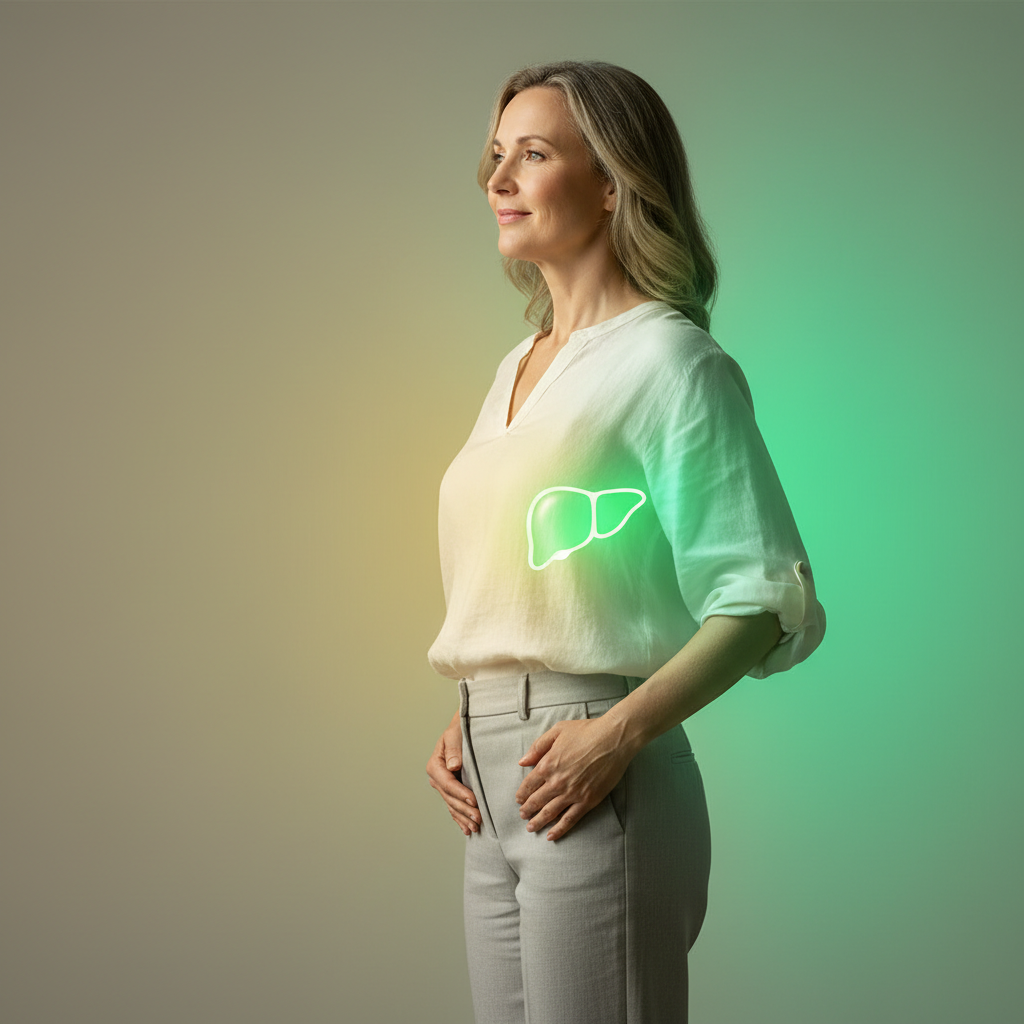
You might associate liver issues with excessive alcohol consumption, but there is a silent shift happening in the bodies of women over 40 that has nothing to do with the cocktail hour. As you move through the perimenopausal transition, your liver begins to process fat differently. What was once a high-functioning metabolic powerhouse may start to accumulate lipid droplets, leading to a condition known as Non-Alcoholic Fatty Liver Disease (NAFLD)—recently renamed by many medical societies to Metabolic Dysfunction-Associated Steatotic Liver Disease (MASLD).
If you’ve noticed a stubborn increase in abdominal girth or a sudden spike in cholesterol despite no change in your diet, your liver might be sending you a distress signal. Understanding the connection between your waning hormones and your hepatic health is vital for long-term longevity.
Why are women over 40 more prone to fatty liver disease?
The statistics are startling: the prevalence of NAFLD in women increases significantly after the onset of menopause, often doubling compared to premenopausal rates. Before age 40, women generally have a lower risk of fatty liver than men. However, once the hormonal shift begins, that protective gap vanishes.
The primary reason for this vulnerability is the loss of the "female advantage" provided by estrogen. Research published in the Journal of Hepatology suggests that estrogen plays a critical role in how the body partitions fat. When levels are high, your body tends to store fat in subcutaneous areas (hips and thighs). As you enter perimenopause, the storage site shifts to visceral fat (around the organs) and ectopic fat (inside the liver).
Furthermore, perimenopause is often accompanied by insulin resistance. When your cells become less responsive to insulin, more free fatty acids are released into the bloodstream and funneled directly to the liver. This "perfect storm" of hormonal decline and metabolic shifting makes the years following age 40 a high-risk window for liver fat accumulation.
How does losing estrogen change how your liver processes fat?
Estrogen is not just a reproductive hormone; it is a metabolic regulator. In the liver, estrogen acts through specific receptors (ERα and ERβ) to keep fat metabolism running smoothly. According to the National Institutes of Health (NIH), estrogen helps to:
- Suppress Lipogenesis: It acts as a "brake" on the creation of new fat cells within the liver.
- Enhance Fatty Acid Oxidation: It encourages the liver to burn fat for energy rather than storing it.
- Reduce Inflammation: It protects liver cells (hepatocytes) from oxidative stress and fibrotic scarring.
When your estrogen levels begin to fluctuate and eventually drop during perimenopause, these protective mechanisms fail. The liver begins to manufacture more fat and loses its efficiency in exporting it. This leads to "steatosis," or the accumulation of fat that exceeds 5% of the liver's weight.
This shifts the liver from being a metabolic filter to a metabolic liability. This transition is often why many women feel like their perimenopause symptoms checklist is growing longer; a sluggish liver cannot effectively detoxify the body or regulate blood sugar, leading to a cascade of systemic issues.
What are the silent signs of NAFLD during the hormonal transition?
One of the most dangerous aspects of fatty liver is its reputation as a "silent" disease. You cannot feel fat accumulating in your liver. By the time symptoms become obvious, the disease may have progressed to Non-Alcoholic Steatohepatitis (NASH) or cirrhosis.
However, there are subtle nafld symptoms in perimenopause after 40 that you should watch for:
- Profound Fatigue: This isn't just "busy mom" tired; it’s a deep, cellular exhaustion that doesn't improve with sleep.
- Upper Right Quadrant Discomfort: A dull ache or a feeling of "fullness" just under the right ribcage.
- Brain Fog: When the liver is overloaded, it can lead to a buildup of toxins that affect cognitive function.
- Increased Abdominal Girth: Often called "menopause belly," this visceral fat is a hallmark sign that the liver is struggling.
- Yellowing of the Eyes (Jaundice): This is a late-stage sign and requires immediate medical attention.
The intersection of these symptoms can be confusing. For instance, if you are also dealing with Hashimoto’s and perimenopause overlap, you might attribute your fatigue strictly to your thyroid. However, the liver is responsible for converting the thyroid hormone T4 into the active T3; if your liver is fatty, your thyroid treatment may not work as effectively.
Does HRT protect the liver or make fatty liver worse?
There is a historical myth that Hormone Replacement Therapy (HRT) is "hard on the liver." This stemmed from older, high-dose oral contraceptives. Modern HRT, particularly when administered through the skin (transdermally), tells a very different story.
According to the North American Menopause Society (NAMS), transdermal estrogen (patches or gels) bypasses the "first-pass metabolism" of the liver. This means the hormone goes directly into the bloodstream without taxing the liver cells.
Clinical evidence suggests that HRT may actually be protective against NAFLD. A study cited by the Endocrine Society found that menopausal women using HRT had significantly lower levels of liver fat and a lower risk of developing advanced fibrosis compared to those not using hormones. If you are considering this route, checking out a HRT for perimenopause beginners guide can help you understand which delivery methods are safest for your metabolic profile.
Can you reverse perimenopausal fatty liver through specific dietary shifts?
The good news is that the liver is remarkably regenerative. In its early stages, NAFLD is often reversible. However, "eating less and moving more" is rarely enough during perimenopause because of the hormonal component. You must eat in a way that stabilizes insulin.
Recommended Dietary Interventions for NAFLD
| Food Category | Action | Why? |
|---|---|---|
| Cruciferous Veggies | Increase | Broccoli, kale, and arugula contain sulforaphane, which aids liver detox. |
| Omega-3 Fatty Acids | Increase | Found in wild salmon and walnuts; reduces liver inflammation and fat. |
| Refined Carbohydrates | Eliminate | White flour and sugar spike insulin, which triggers liver fat storage. |
| Fructose (High Dose) | Avoid | The liver is the only organ that processes fructose; excess turns directly to fat. |
| Choline-Rich Foods | Increase | Egg yolks and sunflower seeds help "export" fat out of the liver. |
In addition to what you eat, when you eat matters. Time-restricted feeding (intermittent fasting) has shown promise in helping the liver clear out stored glycogen and begin burning stored fat, although women should approach fasting gently to avoid triggering cortisol spikes.
Which lab tests should you request to screen for liver health?
Standard physicals often include a "Comprehensive Metabolic Panel" (CMP), but this only scratches the surface. If you are over 40 and experiencing metabolic shifts, you need a deeper dive.
Request the following from your healthcare provider:
- ALT and AST (Liver Enzymes): While these are standard, note that "normal" ranges are often too broad. Optimal ALT for women is typically under 19-25 IU/L.
- GGT (Gamma-Glutamyl Transferase): A sensitive marker for bile flow and oxidative stress in the liver.
- Fasting Insulin: High insulin is a leading indicator of impending NAFLD, often appearing years before liver enzymes rise.
- FIB-4 Score: A calculated score using your age, platelet count, and enzymes to estimate the risk of liver scarring (fibrosis).
- Ultrasound or FibroScan: If blood markers are elevated, an imaging study can confirm the presence of fat or stiffness (scarring) in the liver tissue.
Regular screening is vital, especially if you have other inflammatory conditions. For example, those managing fibromyalgia perimenopause symptoms often have higher levels of systemic inflammation, which can accelerate the transition from simple fatty liver to the more dangerous inflammatory NASH.
How does liver health impact your perimenopause symptom severity?
Your liver is the master regulator of your hormones. It's responsible for breaking down "spent" hormones and preparing them for excretion. If your liver is bogged down by fat, it cannot efficiently clear old estrogen. This can lead to a state of estrogen dominance, where the ratio of estrogen to progesterone is skewed.
This hormonal imbalance can worsen:
- Heavy Period Bleeding: Excess estrogen builds a thicker uterine lining.
- Breast Tenderness: A classic sign of poor estrogen clearance.
- Mood Swings: The "toxic liver/angry mind" connection is well-documented in traditional medicine and increasingly recognized in modern science.
By focusing on liver health, you aren't just preventing a future disease; you are actively improving your quality of life today. A healthy liver means more stable blood sugar, better hormone balance, and more consistent energy levels as you navigate your unruly years. Reducing liver fat is one of the most effective ways to lower systemic inflammation and make the perimenopausal transition a smoother experience.
The path forward after 40 is not about restriction, but about supporting the organ that supports your entire metabolism. With the right labs, the right nutrients, and potentially the support of transdermal HRT, your liver can remain a resilient ally well into your post-menopausal years.
FAQ
Common questions
Is fatty liver reversible after 40?
Yes, in many cases, early-stage fatty liver (steatosis) can be reversed through weight management, stabilizing insulin levels, and reducing sugar intake.
How does menopause affect liver enzymes?
Estrogen helps prevent fat accumulation in the liver. In perimenopause, declining estrogen levels lead to increased visceral fat and a higher likelihood of the liver storing fat.
What are the signs of nafld symptoms in perimenopause after 40?
NAFLD is often "silent," but common signs include persistent fatigue, brain fog, and unexplained weight gain around the abdomen.
Can I take HRT if I have fatty liver?
Transdermal HRT (patches/gels) is generally considered safe and may even be protective for the liver, unlike older oral synthetics.
What is the best test for fatty liver?
Standard liver enzyme tests (ALT/AST), GGT, fasting insulin, and a FibroScan are the most effective ways to screen for liver health during perimenopause.
Want this in your inbox each Sunday?
New articles, the science you can actually use, and the occasional rant.
Keep reading

Perimenopause Symptoms Checklist: 38 Signs You're Not Imagining
A comprehensive, doctor-reviewed checklist of perimenopause symptoms — from the obvious hot flashes to the weird ones nobody warned you about.
9 min read

Hashimoto's and Perimenopause: Why Symptoms Overlap (and How to Tell Them Apart)
Fatigue, brain fog, weight gain, hair loss — Hashimoto's and perimenopause share most symptoms. Here's how to tell what's flaring, what's hormonal, and what to ask your doctor.
11 min read

Fibromyalgia and Perimenopause: When Two Storms Collide
Why fibromyalgia almost always flares during perimenopause, what changes in your nervous system, and the small daily shifts that actually help.
10 min read