
Seed Cycling for Perimenopause: Fact vs. Fiction Explained
Explore the truth about seed cycling for perimenopause hormone balance reviews. Learn the science, the benefits of flax and pumpkin seeds, and if it really works.
Published:
As you navigate the unpredictable shifts of your 40s, you might feel like your body has its own chaotic weather system. One day you’re dealing with night sweats, and the next, you’re searching for a perimenopause symptoms checklist to make sense of the sudden mood swings and fatigue. In your search for relief, you’ve likely encountered "seed cycling"—a dietary practice touted by wellness influencers as a natural way to "reset" your hormones.
But when you’re dealing with the profound physiological changes of the menopausal transition, you need more than just aesthetic health trends. You need to know if the science supports the claims. Can eating specific seeds at specific times of the month actually stabilize your estrogen and progesterone? Or is it simply a crunchy placebo?
What is seed cycling and how does it work?
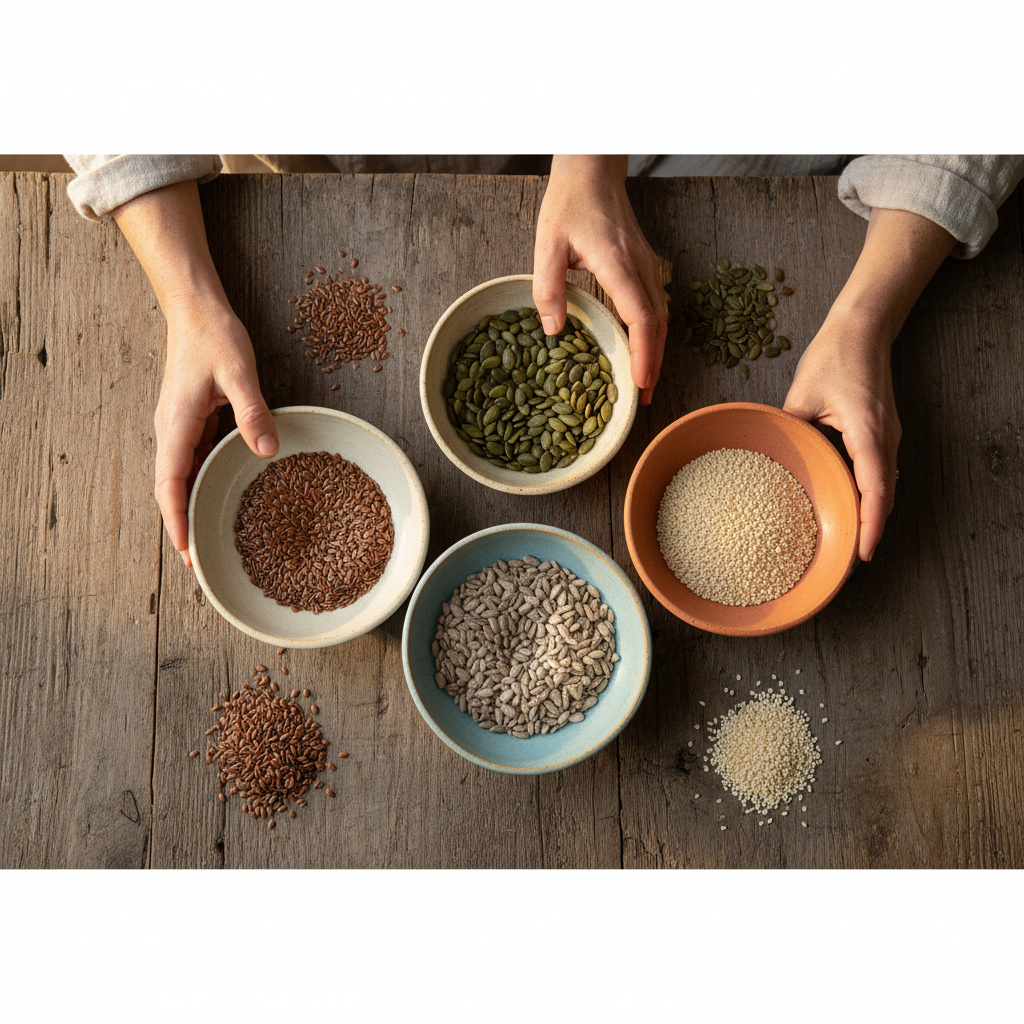
Seed cycling is a naturopathic practice that involves eating specific seeds during different phases of your menstrual cycle to support the balance of estrogen and progesterone. The traditional protocol is divided into two phases, mirroring the typical 28-day female reproductive cycle.
In the first half of your cycle (the follicular phase, days 1–14), you consume one tablespoon each of freshly ground flax seeds and raw pumpkin seeds. This phase begins on the first day of your period and lasts until ovulation. The theory suggests that the phytoestrogens in flax seeds can gently modulate estrogen levels, while the zinc in pumpkin seeds supports healthy follicle development.
In the second half (the luteal phase, days 15–28), you switch to one tablespoon each of raw sunflower seeds and sesame seeds. Proponents claim the vitamin E in sunflower seeds and the lignans in sesame seeds help boost progesterone production, which is crucial for preventing the "estrogen dominance" often associated with perimenopausal symptoms like breast tenderness and heavy periods.
While the concept of using food as medicine is ancient, seed cycling as a formalized protocol is a relatively modern invention. It relies on the idea that the body requires specific fatty acids and minerals to manufacture and metabolize hormones efficiently. However, it is important to distinguish between "supporting" hormonal health and "regulating" a declining endocrine system. As you enter midlife, your ovaries are naturally becoming less responsive to signals from the brain, a process that even the highest quality seeds cannot fully reverse.
Can seeds really regulate a 40+ menstrual cycle?
The perimenopausal cycle is notorious for its irregularity. You might find yourself relating to perimenopause insulin resistance signs or wondering why your once-predictable 28-day cycle has shortened to 21 days or stretched to 45.
The primary challenge with seed cycling in your 40s is that the protocol assumes a standard 14-day follicular and 14-day luteal phase. In perimenopause, ovulation becomes "sporadic." According to the Endocrine Society, hormone levels do not drop linearly; they fluctuate wildly. Because seed cycling depends on knowing when you ovulate to switch seed groups, it can be difficult to track if your body isn't following the "rules."
| Phase | Days | Seeds | Goal | Key Nutrient |
|---|---|---|---|---|
| Follicular | 1 - 14 | Flax & Pumpkin | Estrogen Support | Lignans & Zinc |
| Luteal | 15 - 28 | Sesame & Sunflower | Progesterone Support | Vitamin E & Selenium |
Can these seeds regulate the cycle? There is no clinical evidence that seed cycling can restart a stalled cycle or force a 28-day rhythm on a perimenopausal body. However, the seeds themselves are nutrient powerhouses. For instance, lignans found in flax and sesame seeds can bind to estrogen receptors. In a state of high estrogen (common in early perimenopause), they may have a weak anti-estrogenic effect; in a low estrogen state, they may provide a mild estrogenic boost. This "modulation" is where the perceived benefit often lies, rather than in actual cycle regulation.
The science behind pumpkin, flax, sesame, and sunflower seeds?
To understand if "seed cycling for perimenopause hormone balance reviews" hold weight, we must look at the individual components. The seeds aren't magical, but their nutritional profiles are highly relevant to midlife health.
- Flax Seeds: These are the richest dietary source of lignans. Research published by the National Institutes of Health (NIH) suggests that flaxseed may help improve the estrogen-to-progesterone ratio and has been studied for its potential to reduce the frequency of hot flashes, though results are mixed.
- Pumpkin Seeds: These are exceptionally high in zinc. Zinc is a critical mineral for more than 300 enzymatic reactions in the body, including those involved in hormone synthesis. For women also managing the Hashimotos perimenopause overlap, zinc is vital for the conversion of thyroid hormones.
- Sesame Seeds: Like flax, sesame contains lignans (specifically sesamin). A study in the Journal of Nutrition found that consuming sesame powder improved blood lipids and antioxidant status in postmenopausal women, suggesting a protective effect on cardiovascular health during the transition.
- Sunflower Seeds: These are an excellent source of selenium and Vitamin E. Selenium is crucial for liver detoxification—the primary way your body clears "spent" hormones—and Vitamin E is a potent antioxidant that may help mitigate the systemic inflammation often seen in conditions like the fibromyalgia perimenopause symptoms complex.
While the timing of these seeds may be debated, the nutritional value is undeniable. They provide essential fatty acids (Omega-3 and Omega-6), which are the building blocks of all steroid hormones.
Is seed cycling effective once you start skipping periods?
As you move into late perimenopause, you may go months without a period. This creates a practical dilemma: how do you "cycle" when there is no cycle?
Traditional practitioners suggest following the phases of the moon (New Moon to Full Moon for the follicular phase, and vice versa) as a proxy. While this might sound mystical, it serves as a way to maintain a routine. However, from a strictly medical perspective, the effectiveness of seed cycling specifically for "balancing" hormones diminishes when ovulation becomes rare.
At this stage, your estrogen levels are consistently lower. While seeds can provide lignans, they are unlikely to be potent enough to manage severe vasomotor symptoms (hot flashes). If you find your symptoms are interfering with your quality of life, you might consider an HRT for perimenopause beginners guide to understand how medical intervention compares to dietary support.
The North American Menopause Society (NAMS) notes that while lifestyle and dietary changes (like increasing phytoestrogen intake) can help some women with mild symptoms, they are generally less effective than Hormone Replacement Therapy (HRT) for moderate to severe symptoms.
How to incorporate seeds into a perimenopause diet?
If you want to try seed cycling, the key is consistency and preparation. Seeds should be raw and, ideally, freshly ground to ensure the oils don't go rancid and the nutrients are bioavailable.
Step-by-Step Incorporation:
- Acquire a Coffee Grinder: Whole flax and sesame seeds often pass through the digestive tract undigested. Grinding them breaks the outer shell, releasing the lignans and omega-3s.
- Storage: Store your seeds in the refrigerator or freezer. The high polyunsaturated fat content in seeds makes them prone to oxidation when exposed to light and heat.
- The "Delivery Vehicle": You don't have to eat them plain.
- Stir them into Greek yogurt or coconut yogurt.
- Add them to morning smoothies.
- Sprinkle them over salads or roasted vegetables.
- Mix them into oatmeal or overnight oats.
- Consistency Over Perfection: If your cycle is irregular, don't stress about the exact day you switch. Pick a 14-day window and stick to it. The goal is the cumulative intake of these nutrients over months, not a single-day fix.
Remember that while seeds are healthy, they are also calorie-dense. Two tablespoons of seeds add about 100–150 calories to your daily intake. For many women in perimenopause, metabolic rate slows down, so it’s wise to swap these seeds for other fat sources (like butter or oil) rather than just adding them on top of an already high-calorie diet.
What do the latest studies say about seed cycling's efficacy?
If you are looking for a "gold standard" double-blind, placebo-controlled study on "seed cycling" as a specific protocol, you won't find one. Most clinical research focuses on the individual components of the seeds rather than the cycling method itself.
The Mayo Clinic has commented on flaxseed for menopause, noting that while some early studies were promising, later, more rigorous studies showed flaxseed was not significantly more effective than a placebo for hot flashes. However, they emphasize that flaxseed is still a healthy addition to a diet due to its fiber and heart-health benefits.
Similarly, the Cochrane Library reviewed various phytoestrogens—the active compounds in these seeds—and concluded that while some extracts showed promise, there is no consistent evidence that they are as effective as estrogen therapy.
The "reviews" you see online are often anecdotal. Why might women feel better?
- The "Halo" Effect: Starting seed cycling often coincides with other healthy habits, like reduced sugar intake or better hydration.
- Essential Fatty Acids: Midlife women are often deficient in Omega-3s. Increasing these can reduce systemic inflammation and improve mood.
- Fiber Intake: Most of these seeds are high in fiber, which aids in the excretion of excess estrogen through the gut, potentially reducing symptoms of estrogen dominance.
In conclusion, seed cycling is a low-risk, high-nutrient intervention. It is unlikely to solve severe hormonal imbalances on its own, but it serves as an excellent foundation for a hormone-supportive diet. It provides the minerals and healthy fats your body needs during a time of immense transition, even if the "cycling" part is more folklore than hard science.
If you find that seed cycling isn't enough to manage your symptoms, don't hesitate to consult with a menopause specialist. Dietary seeds are a wonderful "tool" in your toolbox, but they don't have to be the only one. Always listen to your body’s unique signals as you navigate the journey toward radiance. Moving through perimenopause isn't about "fixing" a broken system; it’s about nourishing a changing one. Seeds provide a dense pack of nutrients that support your heart, your brain, and your bones—all of which need extra love during this time. Whether you cycle them or simply eat a variety of them every day, your body will thank you for the nourishment.
FAQ
Common questions
Does seed cycling actually work for hormone balance?
There is no clinical evidence that seed cycling can 'reset' hormones, but the seeds provide essential nutrients like lignans and zinc that support overall endocrine health.
Which seeds are used in seed cycling?
In the follicular phase (Days 1–14), use ground flax and pumpkin seeds. In the luteal phase (Days 15–28), use sesame and sunflower seeds.
How do I seed cycle if my period is irregular?
If your periods are irregular or have stopped, you can follow the phases of the moon (New Moon to Full Moon for phase 1) or simply choose a consistent 14-day rotation.
Do the seeds need to be ground?
Yes, ground seeds are much easier for your body to digest and allow for better absorption of essential fatty acids and lignans.
How long does it take to see results from seed cycling?
Most women report noticing subtle changes in energy, skin, or cycle regularity after 2 to 3 months of consistent seed cycling.
Are there side effects to seed cycling?
While generally safe, seeds are high in fiber. If you aren't used to a high-fiber diet, you may experience temporary bloating or gas. Always consult your doctor if you have a history of estrogen-sensitive conditions.
Want this in your inbox each Sunday?
New articles, the science you can actually use, and the occasional rant.
Keep reading

Perimenopause Symptoms Checklist: 38 Signs You're Not Imagining
A comprehensive, doctor-reviewed checklist of perimenopause symptoms — from the obvious hot flashes to the weird ones nobody warned you about.
9 min read

Hashimoto's and Perimenopause: Why Symptoms Overlap (and How to Tell Them Apart)
Fatigue, brain fog, weight gain, hair loss — Hashimoto's and perimenopause share most symptoms. Here's how to tell what's flaring, what's hormonal, and what to ask your doctor.
11 min read

Fibromyalgia and Perimenopause: When Two Storms Collide
Why fibromyalgia almost always flares during perimenopause, what changes in your nervous system, and the small daily shifts that actually help.
10 min read